Stand at the dock door of any warehouse and watch for ten minutes. Trucks back in on one side. Trucks pull out the other. In between, product moves. That's the whole thing. Every rack, every forklift, every person with a scan gun in their hand is there to manage one gap: what came in this morning against what has to go out tonight.
The Mecalux Technical Warehouse Manual defines a warehouse as a facility that, along with its storage and handling equipment and its people, manages the differences between the flow of goods coming in and the flow going out. Strip the committee language off and you get something sharper: a warehouse is a machine for managing a gap. The two flows never line up. Supply arrives on the vendor's schedule, orders leave on the customer's, and everything in the middle exists to absorb that mismatch.
Get that one idea and the rest of this lesson is detail. Miss it and you'll spend a career specifying equipment for a building instead of designing flow for a system.
By the end of this lesson you should be able to name the five tasks every warehouse performs, classify an operation's flow as simple, medium, or complex from the way material actually moves through it, and read an ABC rotation profile well enough to know what to ask before you ever set foot on the floor.
Strip away the industry, the size, the products. Underneath, every warehouse on earth runs the same five tasks in the same order. A pharmaceutical distributor and a frozen food depot look nothing alike on the floor, and they do the exact same five things.
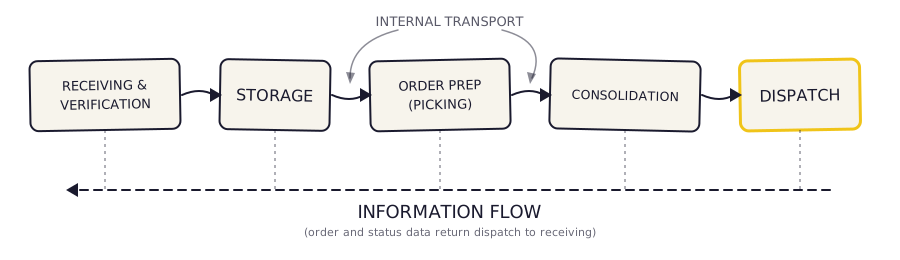
Here are those five tasks drawn as flow. Product runs left to right: receiving, storage, order prep, consolidation, dispatch. Same five tasks, wearing the names you'll see on a floor plan, and the arrows between them are the internal transport. Notice the line running back underneath: that's information, order and status data moving the opposite direction from the product. Systems like a WMS live on that line. You don't design them yet. You learn to see them and get their names in discovery. The deep work on that layer waits for Part V.
Pick a load you have actually watched move: a carton of cans, a tote of picked units, a pallet of cases. Walk it through those five tasks in your head. Now answer one question: which task does it spend the most time waiting in? Not moving. Waiting. That task is where the operation's real cost is hiding, and it's almost never the one the customer calls you about.
Flow is the path material takes through those five tasks. The Mecalux Manual sorts it on a spectrum from simple to complex, and where an operation lands drives every technology decision that comes after.
Your first job on any floor is to name the flow type before you name a single piece of equipment. Misread it and you go one of two wrong directions: over-engineer a simple operation with automation it will never touch, or under-engineer a complex one and watch it choke the day after go-live.
Recommending technology before you've named the flow type. It feels productive. The customer asked about conveyor and you're talking conveyor. But you're solving for a machine before you understand the movement. Name the flow first and the equipment falls out of it. Do it in the other order and you're just guessing with a catalog open.
Not everything in a warehouse moves at the same speed. The Mecalux Manual sorts stored product into three rotation classes, and the mix tells you more about where automation will actually pay off than almost anything else you can ask.
Here's why you ask early. If a customer's top twenty SKUs (a SKU, stock-keeping unit, is one distinct product) are eighty percent of their daily picks, that's a textbook case for high-speed sortation on the fast movers, and that's a number you want in hand before you ever walk the floor.
If the customer's top 20 SKUs are roughly 80 percent of their daily picks, then ask about rotation before you tour, not after. Tradeoff: it can feel premature, like you're reaching for a solution before you've even seen the building. Verify: watch what their answer does to the walk. Where the A items live, how far they travel to the dock, and how many people it takes to move them will reshape everything you look at on the floor.
The five tasks never change. What changes is the world they run in, and two things set that world: the vertical and the environment.
The vertical is who the operation ships for. E-commerce ships a high count of small orders fast, often one item and sometimes a full carton. Retail replenishment pushes cases and full pallets to stores on a schedule. A 3PL like Riverside runs several clients under one roof, each with its own rules. Manufacturing feeds a production line and wants parts in sequence. Same five tasks, very different order profiles, and the profile drives the design.
The environment is the physical condition the work happens in. Food adds hygiene and traceability. Freezer changes the whole solution stack: which conveyor type you can use at all, the sensors, the controls devices, and everything down to the lubricants. Washdown means the equipment gets sprayed down and has to survive water and chemicals. Flag these the moment you see them. They're design drivers, not details, and they get their real treatment in Lesson 17. When you get there, the answers live in the OEM's documentation or one call to them, not in your head.
After enough years you stop seeing buildings. I walk into a facility now and I don't see racks and conveyor. I see flow. Where product comes in, where it piles up, where people are working hardest, where it leaves. The building is just what somebody poured around the flow. Learn to see the flow first and every technical decision after it gets easier, because you're designing for what's actually moving instead of decorating a floor plan with equipment.

Back to Riverside. In your first meeting you asked Dana to walk you through the operation. Here's what she said.
"Our picking operation is split across two zones. Zone A is on the second floor. That is where we handle apparel and housewares. Zone B is on the ground floor in the northeast quadrant. That is packaged food products. Both zones use pick-to-light systems at static shelving. Pickers fill orders and put them on carts. The carts get walked to the staging area near the dock doors on the south wall."
Classify Riverside's flow. Simple, medium, or complex? Write your answer in your Riverside note, then two sentences justifying it from what Dana actually said, not from the size of the company. There's a defensible case for more than one answer here. The classification isn't the grade. The justification is.
This is Lesson 2 of thirty-five, and it's the ground the other thirty-three stand on. Every calculator you'll run, every conveyor you'll spec, every drawing you'll release assumes you already understand the operation it's serving. Product analysis, rate calculations, controls, scoping: every one of them takes its input from your read of the flow. Get the flow wrong here and you carry that error into every lesson after it. See the system, not the building, and the rest of this program is just learning the tools to serve it.