PART I | LESSON 3: READING AN OPERATIONMATERIAL HANDLING ACADEMY
DRIVING QUESTIONWhat is this operation telling me before anyone speaks?
THE FIRST MEETING
You're in a conference room at Riverside Distribution Co. Dana met you at the door and walked you in. Three people are already seated. You came to read this operation, and while you do, every person here is reading you. Listen to how they introduce themselves. Each one is telling you what they care about and what will sink your project if you miss it.
Dana Merrill | Director of Engineering and Technical Operations
"Thank you for coming. Let me introduce the team. Tom Ruiz is our VP of Finance. He will be involved in any capital decisions. Ray from our IT department is here because I have a feeling this project is going to touch some systems and I want him in the room early. And this is Michael Collins, our facilities and maintenance lead. Michael has been in this building longer than anyone. If it moves or makes noise in this facility, Michael knows about it."
"Here is the short version of our problem. We ship for five retail clients. Apparel, housewares, and packaged food products. All outbound sorting is done manually right now. Our associates are making carrier decisions by hand at the staging area near the dock. We are running a misdirect rate of about three percent. Two of our five clients have issued chargebacks. During peak wave releases the staging area becomes a complete bottleneck. I need that to stop."
Tom Ruiz | VP of Finance
"I will be brief. If this project does not make financial sense I cannot support it regardless of the operational benefit. I will need to understand the return before we go any further. Dana can give you the operational picture. I will answer questions about the financial side when you are ready for that conversation."
Michael Collins | Facilities and Maintenance Lead | 20 Years on Site
"We have had equipment in here before. Twice. Neither one of them made it past the first year running the way it was supposed to. I am not against trying again. I just want to make sure somebody actually thinks about how this thing gets maintained and not just how it gets installed."
Ray | IT Systems Administrator
"I am honestly not sure why I am here yet but Dana said to come so I came. We run a WMS. I manage it. If you need to talk to our systems at some point I am the person you need."
Nobody has shown you the floor yet, and the meeting has already handed you the project. Tom led with money, so whatever you design has to pay for itself or it never gets built. Ray isn't sure why he's in the room, which tells you the systems side has been an afterthought here. Dana used one word you should have flinched at: manually. And the maintenance lead, Michael Collins (same name as the man teaching you this course, no relation, good name), said nothing until you made eye contact, then told you two systems have already died on this floor. That's the room reading you back.
By the end of this lesson you should be able to walk into a facility you have never seen and read it before anyone speaks: name where the labor and the pain concentrate, tell a maintained system from an abandoned one, and turn a powered-off conveyor into the one conversation worth having.
The facility walk: read before you ask
Now Dana walks you through the building, and Michael comes along without being asked. That tells you the maintenance lead doesn't trust what happened here last time. Before you ask a single question, start reading, because the operation is already talking. Look first at the manual processes and how many people each one takes. That's where the labor cost sits and where automation has the clearest case. Then look at where people cluster, where product sits idle, and where the floor is worn. A worn path is a vote. It shows you how the space is actually used, not how the drawing says it should be.
FIELD INSIGHT | MICHAEL COLLINS
The first thing I look at is manual processes. How many people does it take to get that task done? That tells you immediately where the labor cost is concentrated and where automation has the clearest case. I talk to full-time employees whenever I can, because they live the current process every day. They know exactly where it breaks down.
FIELD FOOTAGE | Reading a Floor Before Anyone Speaks
Reading a Floor Before Anyone Speaks150 to 180 secondsRecording coming
Michael's walking a real floor on camera for this one. The write-up above carries you meanwhile.
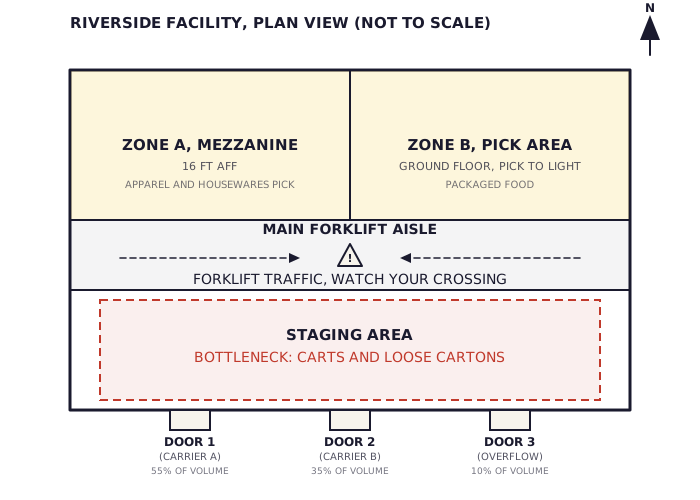
Here's what the walk shows you at Riverside. You start at the dock doors on the south wall. Three doors, two with trailers backed in, one empty. The staging area in front of them is crowded with carts and loose cartons. Two associates are working it, moving fast. And there's a carton sitting in the wrong lane. Neither associate has noticed.
STOP AND THINK
Two associates are moving as fast as they can, a carton is sitting in the wrong lane, and neither of them has caught it. Before you read another word, write down what that one carton tells you. Not what to do about it. What it tells you about the operation, right now, before anyone has quoted a single machine.
Keep walking. North into Zone B, ground floor, pick-to-light shelving. It's orderly. Picks come off the shelves into cartons, cartons go onto carts, and a full cart gets wheeled south toward staging. Then northwest, up the stairs to the mezzanine. Zone A is on the second floor, sixteen feet up, apparel and housewares, the same pick-to-light setup. But these carts have to come back downstairs before they can reach staging. Stand at the mezzanine edge and look down, and the shape of the problem is right there in the building.
Riverside, read as flow. The pick zones are calm. The pain concentrates where the mezzanine, the forklift aisle, and the manual sort all collide above the dock.
Michael Collins, on the walk
"That mezzanine edge is going to be your challenge. Whatever comes down from up here has to land somewhere before it can go south. You have got about 40 feet of horizontal run from the mezzanine edge to where the ground floor zone ends. After that you are in the main aisle. Forklifts run that aisle all shift."
"We had two near misses last year. Carts coming down from upstairs crossing paths with a forklift in the main aisle. Nothing happened but it was close."
He looks at you.
"If you put conveyor across that aisle you need to think about how a forklift gets through."
Reading existing automation
A customer who already has automation just handed you the truest thing in the building. Start by looking, not asking. Is it running, or worked around? Clean, or wearing a hand-lettered out-of-order sign? The physical state of a machine tells you more than any interview can.
The 2025 Modern Materials Handling and Peerless Research Group automation survey makes the point plainly: about half of warehouse operators say order fulfillment is still mostly or fully manual, and most of the rest run a mix of manual and automated processes. So an abandoned system isn't a lazy operation. It's a customer who tried something, got let down, and went back to doing it by hand. That's not a lost cause. That's where the real conversation starts. Before you propose anything new, you have five questions to ask about what's already there.
What does the system do well? What parts of it do the operators actually rely on and trust?
What does it not do well? Where does it slow you down or force a manual workaround?
Has it ever been down for an extended stretch? How did you keep shipping while it was?
Is it tied into your WMS or ERP, and how well does that connection actually work?
If you could change one thing about it, what would it be?
Then ask the one that matters most: if you were starting fresh today, would you install the same system again? That answer tells you whether you're building on a foundation the customer trusts or replacing something that left them with scars. Know which before you draw anything.
WHYExisting automation is the customer's real track record. It shows you what they already bought into, what they believe, and what actually held up on their floor.
WHENAny time a system is already in place. The first three questions are always: is it used, is it maintained, and does everyone who should use it actually use it. Not when: Don't read it as a spec sheet to inventory. You're reading the relationship, not the equipment list. The dust and the workarounds are the data.
WHEREOn the facility walk. What you learn here shapes the interfaces in your requirements and the technology you end up recommending.
FAILURE IF IGNOREDYou pitch new automation to a customer sitting three feet from a system they abandoned, without ever asking why it died. You just told them you didn't look.
PRO TIP | MC
If you see a conveyor sitting powered off, then ask its story before you propose anything at all. Tradeoff: it costs you an awkward minute, standing in front of a machine nobody in the building wants to talk about. Verify: their answer tells you exactly what killed it. A compressor nobody could service, a line that stopped the whole building every time one zone jammed, a vendor who came out twice and never again. That story is the most useful thing you'll hear all day, and it's the one thing a spec sheet can never give you.
Every warehouse has a personality
Step back from the equipment and read the building as a whole, because every warehouse has a personality and it's a design input, not a mood. A clean, well-maintained facility with trained operators is telling you the customer will maintain what you design for them. A chaotic facility is telling you the opposite: the solution you leave behind has to be simpler and more maintainable than whatever they run now, or it joins the pile of things that got installed and abandoned. Riverside is split, calm pick zones and a chaotic sort, and the chaos sits on the exact task Dana wants fixed.
DESIGN PRINCIPLEDesign for the maintenance crew you actually have.
Talk to the people who do the work
You'll hear two versions of how this operation runs. The manager describes how the process is designed to run, the way it works on a good day. The operator describes what it does under pressure, during a wave release when two zones pull at once and there's no time to scan. Both are true, and you need both, because the gap between them is usually where your project lives. New engineers hold questions back because they're afraid of looking uninformed, and the question you were too proud to ask is the one that sinks the project six months later. A customer will answer a hundred honest questions from someone who wants to understand their operation. Ask the operator what they think of the system, and they'll tell you what the good-day version leaves out.
THINK LIKE THE OPERATOR
You already learned to think like the package. Now add the person. Somewhere inside the system you design, at two in the morning on the worst night of the year, one associate is standing in front of a jam with a truck waiting at the dock. Can that one person clear it alone, or does your elegant design need two people and a call to a vendor who won't answer? Michael's one maintenance guy is who you're really designing for. If he can't keep it running, it doesn't matter how well it ran on paper.
RIVERSIDE PROJECT
Facility readout, Riverside. Here's what the operation told you before anyone quoted a machine.
Stated ask. Dana wants a system that reads a barcode and routes each carton to the right dock door. That's the sentence she gave you. It's not the whole job.
Observed problem. A manual carrier sort at the dock with no scan to back it up. You watched a carton sit in the wrong lane and nobody catch it. The three percent misdirect rate isn't a slide, it's happening in front of you. Those misdirects are what triggered the chargebacks Dana mentioned, penalties a retail client bills back to you when their product ships out wrong.
Existing automation and its story. Two systems have already died on this floor, neither one making it past the first year, and nobody in the room defended them. Whatever goes in next is the third attempt, and everyone knows it.
Maintenance reality. The team is one. Whatever goes in has to survive a crew of one. Design for Michael, not for the brochure.
Building constraints. The building fights you at the mezzanine. Sixteen feet up, about forty feet of run to a forklift aisle that runs all shift, and two near misses there last year.
Personality and appetite. Split. Calm pick zones, chaos at the sort, which is exactly the task Dana wants fixed. The operation and the customer agree on where it hurts.
Start the facility readout page in your Riverside note. Write what this operation is telling you and what it has already told you it won't tolerate. Date it, and keep it where you can find it. Every decision you make later answers back to this page.
FOREST THROUGH THE TREES
This is Lesson 3 of thirty-five, and it's the one that runs entirely on judgment. No calculator, no conveyor spec, no drawing. Just you, reading a building before anyone tells you what to think about it. Everything that follows takes its input from this read: get it right and the rest feels nearly obvious, because you already understand the problem you're solving. Rush it, and you spend the project retrofitting your design to a reality you never saw. The operation is always talking. Your job starts with whether you were listening before anyone spoke.
CHECKPOINT
You're touring a beverage distributor's DC. The operations manager describes picking as running smoothly and on schedule. Walking the pick aisles, you notice a foot-worn path cut straight from the shelves to a rework table in the corner, a path that appears on none of the drawings you've been given. What does that worn path tell you about how this operation actually runs? And why would you go find the associate who works that area and ask what they think, instead of taking the manager's description at face value?
Riverside's pick zones run calm and orderly, but the manual sort at staging is chaotic, and that chaos sits on the exact task Dana wants fixed. In a sentence or two: what does that split tell you about the kind of system you should design for the sort area, and why?