Close your eyes for a second. You're not an engineer right now. You're a carton. Somebody just set you down on a conveyor, and you're about to ride it clear across a building you didn't design. What do you feel on the way?
That question separates the engineers who design systems that work in the real world from the ones who design systems that work on paper. It isn't more knowledge of conveyor specs. It's the ability to think like the package. Before you pick a conveyor type, before you open a spec sheet, before you draw a single line, you should be able to trace a package's whole journey through the system you're building, from the package's side of it.
This isn't a metaphor and it isn't a warm-up. It's a design methodology. Every jam, every tipped carton, every product chewed up at a transfer traces back to one moment: the engineer stopped thinking about what the product was going through and started thinking only about what the conveyor was doing.
By the end of this lesson you should be able to close your eyes and trace a package's whole journey through a system before you draw a line, tell easy way from hard way and say why the difference decides how a package rides the rollers, and recognize the core package families and the specialty items that change a system before they surprise you.
So take the ride. You're the carton now, and the system asks something of you at every point along the way. The engineer's job is to hear each question before the product has to answer it the hard way. Here's the whole trip, told from inside the box.
Read that back and notice what it is. It isn't a form you fill out once. It's a running narration you keep going as your eye travels down the layout, section to section. Somewhere in it, on nearly every real system, you'll hit a question the layout can't answer cleanly. That's the spot where you were about to build a jam, and you found it for free, on paper, months before anyone poured concrete.
One more question sits at the end of that list and it's the easy one to skip: who keeps me running? We only name that here; the full call on maintenance against conveyor choice comes later, in Part IV.
Thinking about the conveyor instead of the package. You draw a clean set of lines connecting the entry to the exit, and every line is technically correct, and you never once asked what the product feels going through it. The jams show up later, at the exact points you skipped.
If your layout has more than four or five conveyor sections connected together, then walk the full product journey out loud at least twice before you finalize anything, once for the smallest package and once for the largest. Tradeoff: it feels slow, and you'd rather be drawing. Verify: you'll surprise yourself at least once. The carton exercise finds problems AutoCAD doesn't.
The journey has a hundred questions in it. One of them shapes the ride more than almost any other, and it's decided before the package even touches the first roller: which way is it pointed?
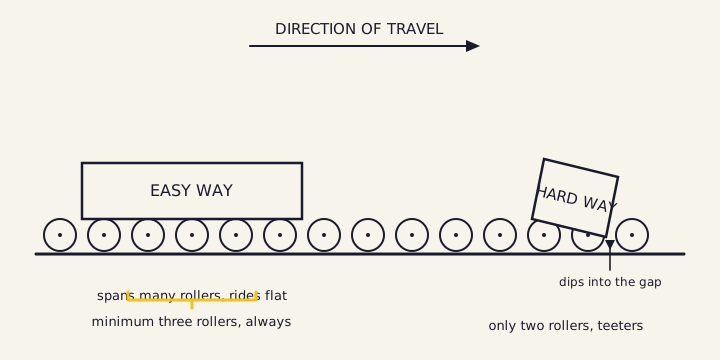
Ride down a roller conveyor and picture what holds you up. You're only ever supported by the rollers your bottom is touching right this second. Your short edge leads, so your long dimension lies down the conveyor, and you span a lot of rollers at once. You sit flat, you ride stable. That's easy way. Turn so your long edge leads instead, and only your short dimension lies along the rollers, so fewer rollers sit under you at any moment. Now you can teeter, and your leading edge can dip into the gap between two rollers before the next one catches you. That's hard way.
Under all of it runs one rule: at least three rollers stay in contact with the package at all times. That's the whole job roller-center spacing does, keeping enough rollers under the shortest box you'll run. Take a 15 by 8 carton. Easy way on 3-inch centers, the 15-inch side reaches across plenty of rollers and it rides fine. Turn that same carton hard way and only 8 inches bridge the rollers, and 8 inches might not reach enough of them to stay level. Same carton, same conveyor, a completely different ride. The only thing that changed was which way it faced.
We're teaching the physical idea here, not the arithmetic. The roller-center math, and the ugly case where a box rides easy way down the main line and then gets turned hard way after a divert, both land later. For now, just learn to see it.
Everything so far assumed a carton, and that's on purpose. The carton is the baseline this whole field is built on. A rigid-bottom, rectangular carton with predictable dimensions transfers cleanly, accumulates predictably, scans reliably, and sorts accurately. When your mix is mostly cartons, the package's journey is a friendly ride.
It rarely stays that simple. Three families run through the systems this program teaches, and only the first one is that easy.
Then there's everything else, and here's the scope guard for this lesson: anything that isn't a carton, a tote, or a soft pack belongs to the specialty-handling category. Tires that roll on their own. Hanging garments that don't have a footprint at all. Irregular items no L by W by H can pin down. We don't crack those open here. Know these exist. Each one bends the whole system around it, and each one earns its own lesson later. The one thing you can't afford is to discover it after the system is built.
Pick a padded mailer you've gotten in the mail. Put it on a roller conveyor in your head and push it forward. What happens when it reaches a curve? When the zone in front of it stops and the package behind it keeps coming? When it hits a transfer? You just found three reasons a polybag isn't a carton.
Tires, polybags, anything that isn't a standard carton, some consideration has to be made, because it can drive the whole solution in a direction you didn't plan for. The question I always ask is what percentage of your volume is this. Five percent or less, you probably don't design the whole system around it, you build an exception path. Twenty percent and you've got a different system entirely. I've seen a system spec'd for standard cartons that turned out to have thirty percent polybags in the mix. Nobody asked. It failed within a month of go-live.

Dana's team sent over the WMS product report she promised in that first meeting. Four products, and this is your first real look at the material the whole system has to carry. We're going to read it, not calculate it. Don't open a calculator. Read each row like a package, not a spreadsheet line.
| Product | Length | Width | Height | Weight | % Volume | Product Use |
|---|---|---|---|---|---|---|
| Small Case | 8" | 6" | 4" | 3 lbs | 4% | Packaged food |
| Standard Case | 13" | 9" | 3" | 12 lbs | 78% | All clients |
| Tall Case | 10" | 8" | 14" | 18 lbs | 12% | Apparel client |
| Large Case | 22" | 15" | 7" | 28 lbs | 6% | Housewares |
Now walk the list as the carton. The Standard Case is 78 percent of the volume and it's a friendly box, longer than it's tall, and it rides easy way without a complaint. That's the one the system gets built around. The Small Case at 8 by 6 by 4 is short, and short is what makes you nervous about roller support the second it turns hard way. Then the Tall Case, 10 inches long and 14 inches tall, stops you cold: a narrow base holding a high center of gravity. That's the one you'd flag the moment you saw it coming off a second-floor mezzanine. You don't design the decline here and you don't run a single number. You just learn to feel which product gives you trouble before any math confirms it.
Write a one or two sentence behavior read for each of the four, in the package's voice where it helps. Which one runs easy, which one is a handling risk, and which one you're flagging and why. Date it and keep it in your Riverside note.
This is one lesson out of thirty-five, and it's the habit the other thirty-four lean on. Every calculator you'll run, every conveyor you'll select, every curve and incline and transfer you'll draw answers back to one question: what is it like to be the package? Lose that question and you're just drawing lines that happen to connect the entry to the exit. Keep it, and you catch the problems while they're still free to fix. Close your eyes and take the ride. Every single time.