MATERIAL HANDLING ACADEMY

Part II. Lesson 6. The MTBH and the Design Envelope.

DRIVING QUESTION Which products should this system actually be built around?
PART II | LESSON 6: THE MTBH AND THE DESIGN ENVELOPE

The Min-Max Trap

A customer sends over a spreadsheet. It lists a smallest package and a largest package, and an engineer sits down and builds a system that handles both ends. It feels like diligence. It's the trap. The min and the max are often edge cases, two percent of volume driving a hundred percent of the design.

Design for the normal day. That's what the system gets built around.

PART II | LESSON 6: THE MTBH AND THE DESIGN ENVELOPE

The MTBH Table: Six Things

The first four are what most engineers collect. The last two decide whether you understood the product or just measured it.

PART II | LESSON 6: THE MTBH AND THE DESIGN ENVELOPE

Min, Max, Average

MINIMUM

A gap problem, not just a small one. Opens a smaller gap on speed transitions, and can arrive with too little gap to act on.

MAXIMUM

Sets your minimum belt width, the inside radius on your curves, and the clearance at transfers and merges.

AVERAGE

Drives speed and throughput. It's what tells you whether the system hits the number the customer asked for.

PART II | LESSON 6: THE MTBH AND THE DESIGN ENVELOPE

The Design Envelope

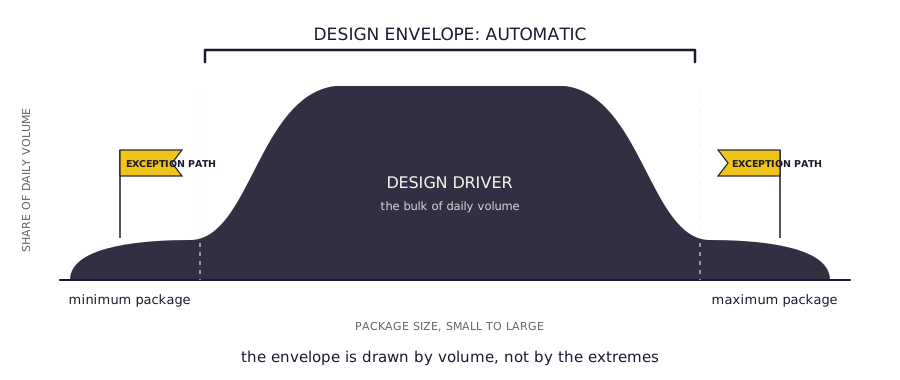
A product mix drawn as a volume distribution: a tall band in the middle is the design driver and the bulk of daily volume, bracketed as the design envelope handled automatically. Thin tails on the left and right, the minimum and maximum packages, are flagged as exception paths.
The envelope is the fat middle. The thin tails get an exception path, not a wider conveyor.
PART II | LESSON 6: THE MTBH AND THE DESIGN ENVELOPE

The Three W's

WHYIt's the agreement between engineer and customer about what the system is designed to handle. It protects both sides when an edge case shows up after installation.
WHENDefined during analysis, before engineering starts. Revisited any time the product mix changes.
WHEREDocumented in the requirements document, then carried into the proposal as scope control.
NOT WHENDon't set the envelope to the customer's full min-to-max range just because that's what the spreadsheet showed. The range isn't the envelope until you know the volume behind each end. Draw the line where the volume tells you to, not where the extremes are.
FAILURE IF IGNOREDSix months after go-live a package jams, and with no documented envelope you've got no way to say whether it was ever inside the design. Every jam becomes a warranty claim and every edge case becomes your fault. An envelope in writing is the one thing that answers whether it was yours to handle.
PART II | LESSON 6: THE MTBH AND THE DESIGN ENVELOPE
COMMON MISTAKE

Taking the customer's min and max as design inputs without asking what percent of daily volume each end represents. The min and max define the range. They don't tell you what the system actually sees day to day. Ask for the volume behind each extreme before you use either one.

PART II | LESSON 6: THE MTBH AND THE DESIGN ENVELOPE
STOP AND THINK

Your mix is 94 percent standard cartons and 6 percent oversized cases. Before you touch a calculator, what's the one thing you need to know about that 6 percent before you decide whether it belongs in the automated system? And what would you do with the answer either way?

PART II | LESSON 6: THE MTBH AND THE DESIGN ENVELOPE
FIELD INSIGHT | MICHAEL COLLINS

Customers almost always give you a generic min and max. Design to both ends of that range without knowing the volume behind each, and you build a system for a package that barely runs through it. The first question I ask after I see a product data set is: what percentage of your daily volume does this minimum package represent? And the maximum? If it's less than five percent on either end, that product might be a candidate for manual handling instead of a design driver.

Michael Collins
PART II | LESSON 6: THE MTBH AND THE DESIGN ENVELOPE
DESIGN PRINCIPLE A system designed to handle everything can be blamed for anything.
PART II | LESSON 6: THE MTBH AND THE DESIGN ENVELOPE

Riverside

RIVERSIDE PROJECT
ProductLengthWidthHeightWeight% VolumeProduct Use
Small Case8"6"4"3 lbs4%Packaged food
Standard Case13"9"3"12 lbs78%All clients
Tall Case10"8"14"18 lbs12%Apparel client
Large Case22"15"7"28 lbs6%Housewares

Build the MTBH table. Name the two outlier candidates and, for each, what it costs to include it and what happens if you leave it out. Recommend a design envelope. Then stop. You don't make the exclusion call alone.

Next: Can this product be conveyed, and in what order do I find out?