MATERIAL HANDLING ACADEMY

Part II. Lesson 7. The Product Decision Chain.

DRIVING QUESTION Can this product be conveyed, and in what order do I find out?
PART II | LESSON 7: THE PRODUCT DECISION CHAIN

The Calculator-First Engineer

There's an engineer on every team who reaches for the calculator the second the product data lands. It looks like competence. It isn't. Open it first, paste in the raw spreadsheet, and it'll happily size the whole system around a carton that's two percent of the volume.

The calculator is the last step, not the first move.

PART II | LESSON 7: THE PRODUCT DECISION CHAIN

The Decision Chain

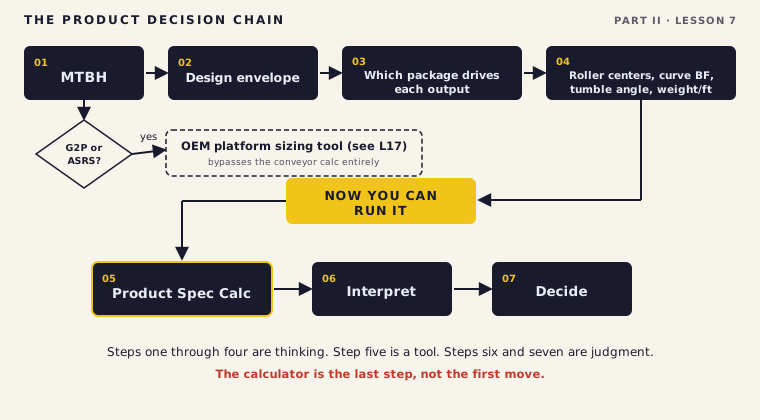
  1. MTBH in hand. The full table, every product the system might see.
  2. Envelope defined. Inside is automatic. Outside is a defined exception path.
  3. Decide which package drives each output. The step people skip.
  4. Work the package-basics outputs. Roller centers, curve width, tumble angle, weight per foot.
  5. Then open the Product Spec Calc. Not before.
  6. Interpret. Read the outputs against the thinking you already did.
  7. Decide. Make the engineering call the numbers can't make for you.
PART II | LESSON 7: THE PRODUCT DECISION CHAIN
The product decision chain as a left-to-right pipeline: MTBH, design envelope, which package drives each output, and roller centers, curve width and tumble angle. A gold gate precedes the Product Spec Calc, then interpret, then decide. A branch off MTBH asks whether the system is goods-to-person or ASRS, which routes to an OEM platform sizing tool that bypasses the conveyor calc.
The calculator is the last step, not the first move.
PART II | LESSON 7: THE PRODUCT DECISION CHAIN

Package-Basics Outputs

Weight per foot

Carton weight over its length in feet. Worst case is the heaviest carton at its shortest length.

Curve between-frame width

The worst-case carton in a curve sets it. Round up to the next catalog width, never down.

Tumble angle

The max incline before a carton tips. Design to the minimum in the mix, with margin.

Roller centers

Leading dimension over three, so three rollers are always under the package. The one people trust without looking.

PART II | LESSON 7: THE PRODUCT DECISION CHAIN

When the Calculator Changes

The Product Spec Calc is the authority for conventional conveyor. It stops being the authority on specialized platforms. Goods-to-person systems and ASRS come with their own sizing tools, built around tote dimensions, throughput, and cycle time, not conveyor math.

The rule is plain: identify the platform early, get the manufacturer's tool, and never substitute a general calculator for a manufacturer-specific one.

PART II | LESSON 7: THE PRODUCT DECISION CHAIN

The Three W's

WHYIt's the translation layer from what the customer handles to what the engineering must deliver. Without it, engineers guess. With it, they calculate. That's the difference between a system that works and one that almost works.
WHENEvery time you have product data and are about to specify a conveyor-based system, and only after the MTBH and envelope are set. Run it again the moment the product data changes.
WHEREIts outputs feed width, roller centers, curve geometry, incline, and every rate calc downstream. Everything past it inherits its numbers.
NOT WHENNot first. Not before you've decided which package drives each output, and not on a system that's really a goods-to-person or ASRS problem in disguise. On those, this calc isn't the authority. The manufacturer's tool is.
FAILURE IF IGNOREDOpen it first and paste in the customer's raw spreadsheet, and it'll size the whole system around a package that's two percent of the volume. The number's right and the design's wrong, and you won't know until it's built.
PART II | LESSON 7: THE PRODUCT DECISION CHAIN
COMMON MISTAKE

Treating the calculator output as the decision. The calc produces numbers. It can't tell you whether the max carton that's driving your belt width belongs in the system at all. That's a volume question and a customer conversation, not a cell in a spreadsheet. Run the number, then do the thinking the number can't do for you.

PART II | LESSON 7: THE PRODUCT DECISION CHAIN
STOP AND THINK

Someone hands you a filled-out Product Spec Calc for a project you've never seen and says the numbers check out. What's the first question you ask before you trust a single output on that sheet?

PART II | LESSON 7: THE PRODUCT DECISION CHAIN
DESIGN PRINCIPLE Calculators are step five, not step one.
PART II | LESSON 7: THE PRODUCT DECISION CHAIN
FIELD INSIGHT | MICHAEL COLLINS

Here's the thing about any calculator I've ever built. A student who understands why the formula works will catch a bad input every time. A student who just types numbers in and trusts what comes out will not. The calc isn't there to think for you. It's there to do the arithmetic fast so you can spend your judgment on the part that actually matters, which is deciding what should have gone into it in the first place.

Michael Collins
PART II | LESSON 7: THE PRODUCT DECISION CHAIN

Riverside

RIVERSIDE PROJECT
ProductLengthWidthHeightWeight% VolumeProduct Use
Small Case8"6"4"3 lbs4%Packaged food
Standard Case13"9"3"12 lbs78%All clients
Tall Case10"8"14"18 lbs12%Apparel client
Large Case22"15"7"28 lbs6%Housewares

Walk the chain with the calc closed. Write down which package drives roller centers, which drives belt width, and which you'd flag for the decline. Then open the calc and check your answers against the outputs.

Next: What does material actually do in this building, before I draw any equipment?