The Anatomy
Part IV. Lesson 11. How Conveyors Work.
The machine that has to survive the customer
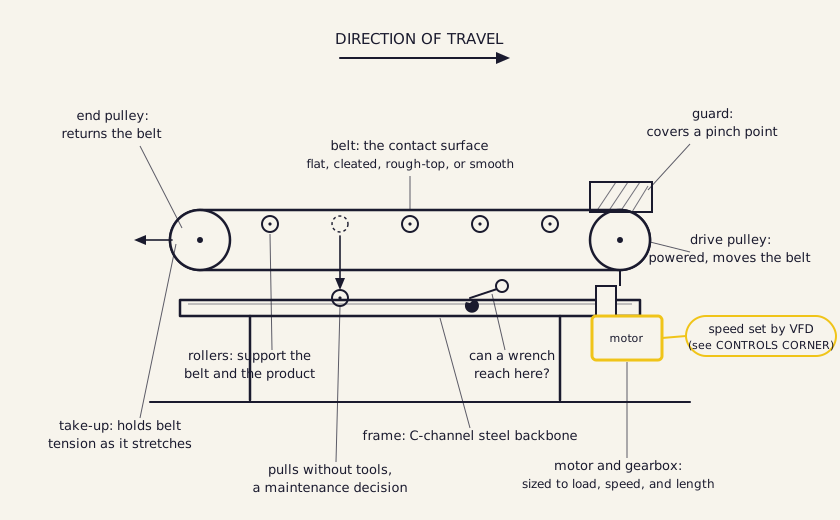
A conveyor isn't a drawing. It's a machine that runs two shifts a day in a real building, with real dust, real temperature swings, and a maintenance team that might be one person fixing whatever broke last night. The drawing shows you steel. It doesn't show you the wear.
Every component on a conveyor was built the way it was for a reason. Learn the reason behind each part and you can walk up to a conveyor you've never seen, read it from its components, and know how it'll behave before anyone hands you a spec sheet.
Picture a belt conveyor that has run two shifts a day for a year. Name three things on it that aren't the same as the day it was commissioned. Now name which of those three a one-person maintenance team would actually catch before it caused a jam. No calculator. Just the machine and the person who has to keep it alive.
Designing a line you can't service. Two 24-inch units butted together, and now there's no room to get a wrench in, no room to pull a motor, no room to swap a bearing. It all fit on the drawing. It doesn't fit a maintenance guy at 2 AM with a jam and a flashlight.
Always ask about maintenance capability early, and not just whether they have a team. Ask what that team actually does. A place that only fixes what breaks needs a simpler, more durable conveyor than a place with a real PM program. When you're not sure whether a point just needs to move product through or will sometimes need to hold it, default to holding it, because you can always run an accumulation conveyor straight through, but you can't add accumulation after it's installed. And where there's no maintenance to speak of, a motor-driven roller system can be a good choice. It just usually costs more. Match the machine to the reality, not just the product.

"First one was a pneumatic accumulation system. Worked fine for about four months. Then the compressor started having issues. Air pressure would drop during peak volume and the zones would stop releasing cleanly. Nobody was trained to work on it. Six months after install it was off and we were back to manual." "Second one. When anything downstream slowed down, everything stopped. The whole line. Every time. We lasted three months before it came out."
Write your component-and-maintenance read note. Two or three sentences per failure: what kind of machine failed, and why it failed in this building. Don't name the replacement. That's next lesson's work.
A conveyor's drive doesn't just switch on. On a lot of systems the belt has to come up to speed gently and slow down gently, and that's the job of a variable frequency drive. A VFD sets belt speed electronically, so the same conveyor can run at different rates as the operation changes, and it ramps that speed up and down instead of slamming the belt from stopped to full and back. Some conveyors flat out require it, because a hard start throws product around and a hard stop tips it over. Here's the control reality: the VFD is the piece that turns "how fast should this run" from a mechanical fact into a number somebody sets and tunes. How that number gets set is Part V, Lesson 20. For now, know that the drive is the first place the controls system reaches into the steel.
Next: Does this point in the system move product, or does it hold product?