Part IV. Lesson 12. Transportation vs Accumulation.
The two systems that failed in the same building
Michael Collins has watched two conveyor systems come and go on this floor. The first ran on air. It worked for about four months, then the shared compressor couldn't hold pressure at peak, the zones stopped releasing cleanly, and nobody on site was trained to fix it. The second one stopped the whole line every time anything downstream slowed. Every time.
Two failures, and they're the same lesson told from two directions. Somebody got the transportation-versus-accumulation call wrong, or got the mechanism behind that call wrong.
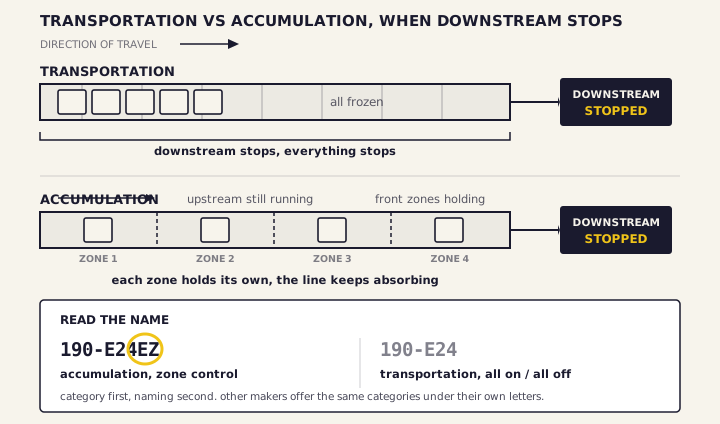
Moves product from A to B at one speed. Product doesn't pause, it doesn't queue, and if something stops downstream, the whole unit stops with it. A sorter, a transfer, a diverter, and a belt curve are all transportation.
Moves product too, but it can also hold product in its zones, without damage and typically without pressure, when the downstream process isn't ready. The zone absorbs the gap between the rate product arrives and the rate it can be processed.
| Model name | Category | What the name tells you |
|---|---|---|
| 190-E24 | Transportation | E24 motor-driven-roller zones. All on, all off. No zone logic. |
| 190-E24EZ | Accumulation | E24 zones plus EZLogic. Zone-level electric accumulation. |
| ABLR | Transportation | Belt-driven live roller. All on, all off. No zone logic. |
| ABEZ | Accumulation | Belt-driven live roller with EZLogic. Zone-level pneumatic control, zones held by air. |
| NSP | Transportation | Line shaft. All on, all off. |
| NSPEZ | Accumulation | Line shaft with EZLogic. Zone-level pneumatic control, zones held by air. |
| Characteristic | E24EZ, motor-driven roller | ABEZ, pneumatic |
|---|---|---|
| Drive mechanism | Motorized roller per zone | Pneumatic actuator per zone |
| Zone stop response | Electric signal, consistent | Air pressure, variable with supply |
| Maintenance profile | Motor replacement, roller bearings | Air fittings, bladders, filters, dryers |
| Pinch points and air | No air infrastructure, no pinch points | Needs clean, dry air; introduces pinch points |
Reading EZ as marketing instead of architecture. EZ means zone controllers and transducers on every zone and a real Aux I/O question to answer. Miss it at design and you find the missing Aux I/O at commissioning, a panel modification at the worst possible time. And the mirror image: assuming a sorter or a transfer can accumulate. It can't. If product has to queue before it, the accumulation lives on a separate conveyor upstream.
Not all conveyors are created equal, even when they carry the same category name. Zero-pressure accumulation is a function, not a specification. An E24 and an ABEZ are both ZPA, but one's electric and one relies on air, and air fluctuates. That difference matters when you need consistent zone-to-zone timing. Before you select an accumulation conveyor, understand the mechanism. Ask the manufacturer how the zone stops, how it releases, what the response time is, and how that response varies under load. Call the manufacturer directly during design, and the controls engineer too. Peer review isn't a weakness, it's professional practice.

If you're choosing between electric and pneumatic accumulation on cost, then run the total installed cost for both on this exact run length, motor and starter or VFD, panel components, air supply, and labor included, not the price per zone. Tradeoff: it's more work than reading a unit price off a catalog. Verify: the answer flips with run length. If your short-run instinct said ABEZ is cheaper, the total cost may say otherwise, and only the total cost is a number you can defend.
On an electric accumulation conveyor, every zone has its own small brain. A motor-driven roller runs on a driver card, and a zone controller decides, from its own photoeye and a quick word with the zones on either side of it, whether to run or stop. The control reality worth carrying forward: those zones talk to each other directly, in a daisy chain along the conveyor, without routing every decision through the PLC. That's the whole point of self-contained zone control, it takes the moment-to-moment accumulation off the PLC's plate. The PLC only gets involved where you deliberately give it a way in, which is the next lesson's concept and Part V's depth in Lesson 20. For now: an electric zone responds to a signal, every time, which is exactly why it behaves the same whether the compressor is happy or not.
Next: How much accumulation does this buffer need, and how should it release?