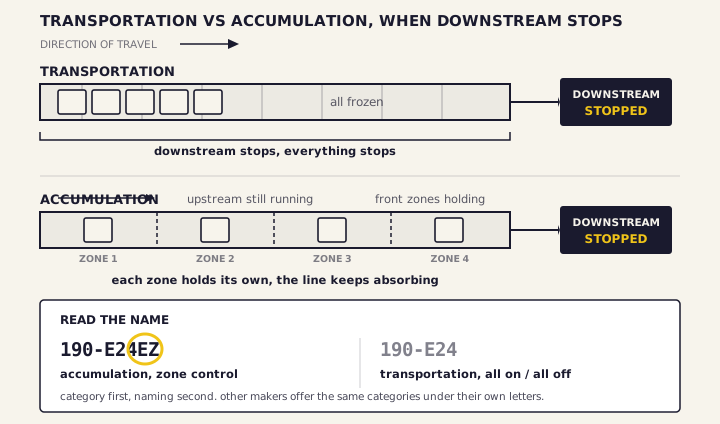
Michael Collins has watched two conveyor systems come and go on this floor. The first ran on air. It worked for about four months, then the shared compressor couldn't hold pressure at peak, the zones stopped releasing cleanly, and nobody on site was trained to fix it. Six months after install it was off. The second one stopped the whole line every time anything downstream slowed. Every time. It lasted three months before it came out.
Two failures, and they're the same lesson told from two directions. Somebody got the transportation-versus-accumulation call wrong, or got the mechanism behind that call wrong. It's one of the most consequential and most common mistakes in conveyor design, and it gets made before a single conveyor is selected.
By the end of this lesson you should be able to walk a layout and flag every point where product may have to wait before you've selected a single conveyor, read a model name and know its control architecture in two letters, tell electric zero-pressure from pneumatic and say why the same category name can behave two different ways, and run the total installed cost instead of the unit price when you choose between accumulation platforms.
Start with the distinction everything else hangs on. Transportation and accumulation aren't conveyor types you pick off a catalog page. They're functions, and every point in a system needs one or the other.
A transportation conveyor moves product from A to B at one speed. Product doesn't pause, it doesn't queue, and if something stops downstream, the whole unit stops with it. That's not a flaw; it's right when the downstream process is always ready to take product at the rate the conveyor delivers it. A sorter, a transfer, a diverter, and a belt curve are all transportation.
An accumulation conveyor moves product too, but it can also hold product in its zones, without damage and typically without pressure, when the downstream process isn't ready. The zone absorbs the gap between the rate product arrives and the rate it can be processed. Leave it out where the flow needed it and the system fails every time anything downstream needs a brief pause. The call isn't always binary, either: a transportation conveyor often feeds an accumulation conveyor, and that connection has to be engineered so the transportation unit doesn't cycle on and off too often.
Any point in a system where product may need to wait, before an induction, before a merge, before a scan point, before a manual process, before a sorter, before a pack station, before a dock door, is a point where accumulation must be evaluated.
The question is never whether accumulation is needed at that point, only how much and what type, and that sizing is Lesson 13. The skill here is recognizing the points in the first place, before you've selected a single conveyor.
You're standing at a layout with a scan point, then a merge, then a sorter, then three pack stations. Walk it and mark every place product might have to wait, before you name a single conveyor. How many did you find? Now ask which of those you'd have missed if you'd started by placing equipment.
Here's a field skill you'll use every time you open a drawing or a quote. In the Hytrol product line, the transportation-versus-accumulation distinction maps straight onto the model name. No EZ in the name means transportation: all on, all off, no zone logic. Think 190-E24, ABLR, NSP, plus the sorters and transfers. EZ in the name means accumulation with self-contained zone control: a controller and a photoeye on every zone, able to accumulate without pulling the PLC into every zone decision. Think 190-E24EZ, ABEZ, NSPEZ. Those two letters tell you the whole control architecture, whether you'll need to plan for Aux I/O, and how the zone behaves when product backs up.
Now the caveat, and it carries as much weight as the skill. This naming is Hytrol-specific. Other manufacturers offer the identical categories, motor-driven-roller zero-pressure accumulation, belt-driven live roller, line shaft, under their own naming. You're not memorizing one vendor's letters; you're learning to recognize an accumulation platform and its mechanism. Category first, naming second.
| Model name | Category | What the name tells you |
|---|---|---|
| 190-E24 | Transportation | E24 motor-driven-roller zones. All on, all off. No zone logic. |
| 190-E24EZ | Accumulation | E24 zones plus EZLogic. Zone-level electric accumulation. |
| ABLR | Transportation | Belt-driven live roller. All on, all off. No zone logic. |
| ABEZ | Accumulation | Belt-driven live roller with EZLogic. Zone-level pneumatic control, zones held by air. |
| NSP | Transportation | Line shaft. All on, all off. |
| NSPEZ | Accumulation | Line shaft with EZLogic. Zone-level pneumatic control, zones held by air. |
| Sorters, transfers | Transportation | All on, all off. They divert or transfer on a single command from the PLC. |
Reading EZ as marketing instead of architecture. EZ means zone controllers and transducers on every zone and a real Aux I/O question to answer. Miss it at design and you find the missing Aux I/O at commissioning, a panel modification at the worst possible time. And the mirror image: assuming a sorter or a transfer can accumulate. It can't. If product has to queue before it, the accumulation lives on a separate conveyor upstream.
Zero-pressure accumulation, ZPA, is a function: accumulate product without contact pressure between packages. It's not a specification. Two conveyors can both wear the ZPA label and behave measurably differently in the same application, because the label tells you what they do, not how they do it.
Electric ZPA, the 190-E24EZ, the E24 zones running EZLogic, drives each zone with its own motorized roller. Zone stops are electric, so they respond consistently regardless of ambient temperature, air supply, or compressor performance. It's easier to install and maintain, there's no air infrastructure, there are no pinch points, and the rollers can be stopped by hand, which matters where people work near the conveyor.
Pneumatic ZPA, the ABEZ, controls its zones with air acting on bladders and actuators, so its behavior depends on the stability and quality of the air supply. Air that fluctuates, from compressor cycling, a demand spike elsewhere, or a leak, produces less consistent zone behavior, and a pneumatic zone typically stops a package slightly less quickly than an electric one under the same load. That isn't a knock on the technology; pneumatic is a proven platform with a long track record. The point is that one responds to a signal and the other to air, and air fluctuates.
This is Riverside's first failure named exactly: an air-dependent system in a building whose shared compressor couldn't hold pressure at peak, with parts nobody was trained to service. The mechanism was wrong for the facility, and the category name never would've told you that.
| Characteristic | E24EZ, motor-driven roller | ABEZ, pneumatic |
|---|---|---|
| Drive mechanism | Motorized roller per zone | Pneumatic actuator per zone |
| Zone stop response | Electric signal, consistent | Air pressure, variable with supply |
| Maintenance profile | Motor replacement, roller bearings | Air fittings, bladders, filters, dryers |
| Pinch points and air | No air infrastructure, no pinch points | Needs clean, dry air; introduces pinch points |
Not all conveyors are created equal, even when they carry the same category name. Zero-pressure accumulation is a function, not a specification. An E24 and an ABEZ are both ZPA, but one's electric and one relies on air, and air fluctuates. That difference matters when you need consistent zone-to-zone timing. Before you select an accumulation conveyor, understand the mechanism. Ask the manufacturer how the zone stops, how it releases, what the response time is, and how that response varies under load. Those are engineering questions you should answer before you commit the conveyor to a drawing. Call the manufacturer directly during design, and the controls engineer too. Peer review isn't a weakness, it's professional practice.

Once you know a point needs accumulation, you pick the mechanism, and there's an order to it. First filter is weight and speed. Every accumulation model publishes a weight capacity and a maximum speed. Check them against your Product Spec Calc outputs before anything else. If the product weight or the required speed exceeds the rating, that model is out, regardless of cost or run length. It's a hard specification limit, not a preference.
This is where the weight-per-foot check lives. Weight per foot is carton weight divided by carton length in feet, and the worst case is the heaviest carton at its shortest length, not the average. The Calc Logic Guide is the authority for that formula; run it there. If the worst-case number exceeds a motor-driven-roller platform's published rating, MDR is eliminated at that point, and you don't argue with a hard limit.
Second is accumulation behavior and operational fit. Electric favors controlled gaps, consistent spacing, and personnel safety, and because every zone runs its own motor, each zone can run its own speed, which is what you want when you're metering or indexing into an induction; a shared pneumatic drive runs every zone at one speed. Pneumatic is the natural conversation when product needs to bunch, and it brings air infrastructure and pinch points along with it.
Third, and this is the one that surprises engineers, is run length and economy of scale. E24 costs more per zone; that's true. But on a short run it can be cheaper total, because ABEZ carries a fixed cost: a high-voltage centralized motor and its panel components. As the run gets longer, that fixed cost spreads across more zones and the equation can flip. So run the total installed cost for both options on this run length and configuration, and let the numbers decide.
| Factor | E24EZ, motor-driven roller | ABEZ, pneumatic |
|---|---|---|
| Default accumulation | Singulated, one package per zone with gaps | Can be configured to bunch product |
| Zone speed | Each zone sets its own independent speed | Centralized drive, all zones run one speed |
| External utilities | Low-voltage DC power only | High-voltage AC power plus compressed air |
| Controls components | Zone controllers only, minimal panel additions | Motor starter or VFD, overload, air filtration |
| Short run, total cost | Lower, simpler electrical, no motor panel | Higher, motor and panel are fixed cost |
| Long run, total cost | Higher, zone controllers scale with length | Lower, fixed motor cost spreads over more zones |
If you're choosing between electric and pneumatic accumulation on cost, then run the total installed cost for both on this exact run length, motor and starter or VFD, panel components, air supply, and labor included, not the price per zone. Tradeoff: it's more work than reading a unit price off a catalog. Verify: the answer flips with run length. If your short-run instinct said ABEZ is cheaper, the total cost may say otherwise, and only the total cost is a number you can defend.
This lesson makes the call and picks the mechanism. It stops there. How much accumulation a buffer needs and how it releases, the zone count, the release mode, and the weight-per-zone check, are Lesson 13. Aux I/O implementation is Lesson 20 in Part V. Total installed cost as a business case and payback is Lesson 29. Here it's a selection principle, not a spreadsheet.
Back to Riverside. In Lesson 11 you read Michael's two failure stories as component and mechanism stories. Now you diagnose them formally, and you let them point the technology direction. Here's what Michael told you when you asked what happened with the previous systems.
"First one was a pneumatic accumulation system. Worked fine for about four months. Then the compressor started having issues. Air pressure would drop during peak volume and the zones would stop releasing cleanly. Maintenance calls started coming in. Nobody was trained to work on it. The vendor sent someone out twice. After that the operators started pushing product around the jammed zones by hand. Six months after install it was off and we were back to manual."
"Second one. When anything downstream slowed down, everything stopped. The whole line. Every time. We lasted three months before it came out."
Now you can name both failures precisely. The first was a pneumatic ZPA system whose zone behavior depended on air, in a facility with a shared compressor that dropped pressure at peak, and parts a maintenance team of one was never trained to service. The second was transportation placed where the flow needed accumulation, so one downstream slowdown stopped the whole line. Both point the same way: electric ZPA is the natural conversation, given a maintenance team of one and the need for consistent gaps into a sorter, and accumulation belongs wherever the flow says product waits.
Walk Riverside's outbound flow, the throw-on lines, the point before the merge, the point before the sorter, the points before the pack stations, and produce the transportation-versus-accumulation map. Mark every point that has to hold product. Then state a technology direction and justify it with the two failures. Don't size the zones yet; that's Lesson 13. Don't design the merge; that's Lesson 15. The deliverable is the map and the justified direction.
Part IV is where the flow you validated in Part III turns into steel, and this is the lesson that makes the first real technology call. Every selection after it inherits this one. Get the call and the mechanism right, and Lesson 13 sizes the accumulation, Lesson 15 designs the merges, and Lesson 16 picks the sorter, each standing on something you can defend. Get it wrong here and no downstream cleverness saves the system, because you'll have put transportation where the flow needed to wait. Read the name, know the mechanism, run the total cost. That's the whole lesson, and it happens before a single conveyor goes on a drawing.
On an electric accumulation conveyor, every zone has its own small brain. A motor-driven roller runs on a driver card, and a zone controller decides, from its own photoeye and a quick word with the zones on either side of it, whether to run or stop. The control reality worth carrying forward: those zones talk to each other directly, in a daisy chain along the conveyor, without routing every decision through the PLC. That's the whole point of self-contained zone control, it takes the moment-to-moment accumulation off the PLC's plate. The PLC only gets involved where you deliberately give it a way in, which is the next lesson's concept and Part V's depth in Lesson 20. For now: an electric zone responds to a signal, every time, which is exactly why it behaves the same whether the compressor is happy or not.