The Thirds Method
Part IV. Lesson 14. Changing Direction and Elevation.
A straight run of conveyor forgives a lot. A curve doesn't forgive that. Neither does an incline or a decline. Each one puts a specific set of forces on the package, and each one is a place where a correct static calculation still hands you a design that fails on the floor, because the engineer stopped at the number and never asked what the carton feels when the belt starts, when it stops, and when the load inside it slides.
It's the diagonal of the package, not the width, that decides how much belt it needs to keep every corner inside the footprint through the turn.
The curve output is almost always wider than the straight sections need. The curve becomes the specification for the system, and the straight runs follow the curve. Run the curve requirement first, before you commit any belt width.
I'm heading into a curve. Are my corners going to swing past the edge of the belt, or is it wide enough for my diagonal? Now the floor tilts up under me. When the belt lurches into the climb, does my weight throw back toward my trailing edge? Is my load already sitting toward the back? Am I tall on a narrow base, so it doesn't take much to put me over? Now I'm heading down. When the belt stops, does everything in me pitch toward my leading edge and try to tip me forward? How steep is this, and is there enough friction under me that I'm not sliding instead of riding? What's holding me up on this gravity section, is it always at least three rollers, or am I about to drop into a gap?
The static tumble angle is where a stationary package on a stationary incline tips with nothing but gravity acting on it. It hasn't cleared the field.
Inertial energy. When the belt starts or stops, the acceleration adds energy the static picture left out.
Load shift. A carton with contents that can move isn't a uniform block. If the load slides to one end, the center of mass goes with it.
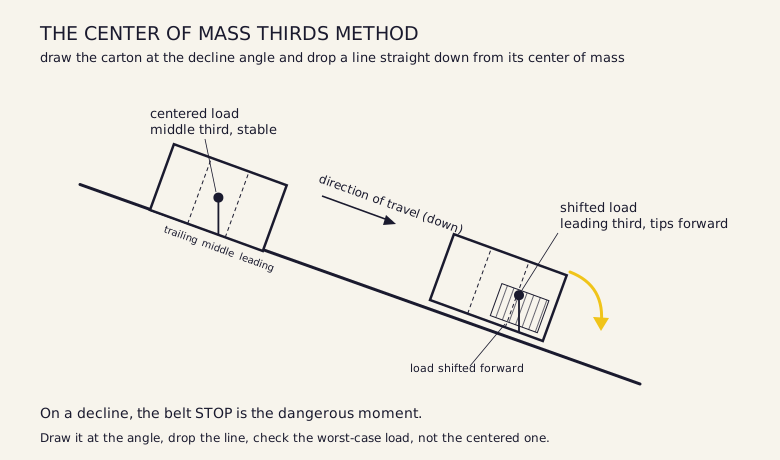
On an incline the danger is startup, tipping backward. On a decline the danger is the stop, tipping forward.
Picture a box of loose paperback books on a belt that starts an incline with a jerk. What happens to the books inside the box at that instant, and which way does the box want to go? Now picture the same box on a decline when the belt stops hard. Same question, other direction. You just described the two moments a static tumble number can't see.
Treating the static tumble angle as the only check. The static number covers a stationary package with a centered load. It says nothing about belt startup on an incline, the stop on a decline, or the load that shifted to one end inside the box. A design that passes the static check and ignores those can still tip in the field, and it'll tip at the exact moment, the start going up or the stop coming down, that the static number never modeled.
The mezzanine deck is at 16 feet above finished floor with about 40 feet of run. Work out the steepest decline angle that fits in that run, then check every product in the design envelope against its tumble limit. Watch the Tall Case, the 10 x 8 x 14 apparel box, 14 inches tall on an 8-inch base, the tippy one. Draw it at your decline angle and run the thirds method on it with the load shifted forward, name the stop at the bottom as the dangerous moment. If the Tall Case can't safely ride the angle your geometry allows, don't assume it works out. Document it and bring Dana the options.
The fix for the inertial energy you just met is partly mechanical margin and partly a controls setting: the VFD ramp rate. A slower ramp means a gentler start and a gentler stop, which means less peak inertial force on the package at exactly the two moments it wants to tip. That ramp time isn't a knob someone turns in the field once and forgets. It's a PLC parameter that has to be specified in the controls design, and it has to be compatible with the conveyors on either side. The angle you designed and the ramp you need are two halves of the same decision.
Next: What breaks when product changes direction, or two flows become one?