Part IV. Lesson 15. Transfers and Merges.
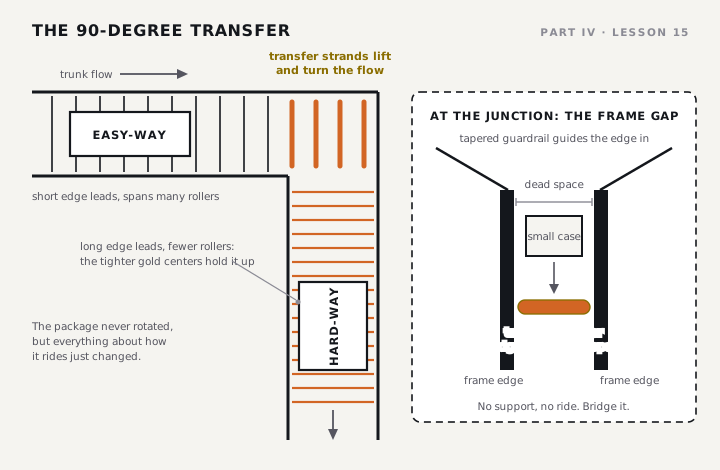
A ninety-degree transfer diverts a package off the trunk line at a right angle. Watch one happen and you'll swear the package turned. It didn't. But the takeaway runs the other direction, so now its long edge leads and only the short dimension lies down the takeaway. It's riding hard-way, and it never turned to get there. That's the move new engineers miss, because they watch the conveyor instead of the package.
I've been riding easy-way down the trunk, my short edge leading, plenty of rollers under me, steady. Now strands come up between the rollers and shove me sideways off the line. I didn't spin. I'm the same way around I always was, but the takeaway runs the other direction, so now my long edge is leading and there are barely enough rollers under me. Is the spacing tight enough to hold me up hard-way, or am I about to teeter? There's a gap where these two frames meet, am I going to bridge it or drop a corner into it? Is the guardrail tapered to guide my leading edge in, or is it going to catch me and spin me?
The photoeye sits upstream of the strands, so the PLC waits a calculated delay while the package travels from the sensor to the strands, then stops it.
That delay is reliable on day one and less reliable a year in. As O-rings stretch and dry out, slippage climbs and the stopping position drifts.
The correct response isn't a tighter delay. It's clearance-by-design: size the takeaway so the longest carton clears both side frames even as the stop position varies.
Trying to solve stopping drift with a tighter delay. O-rings degrade, air pressure varies, product weight varies, and the stop position moves over the life of the system no matter how good the day-one delay was. The fix isn't a delay that's only correct when everything's ideal. It's clearance: size the takeaway so the longest carton clears both frames even as the stop position drifts. You design that in from the start, or you change the takeaway geometry later.
One principle: the PLC releases one lane at a time so product zippers into single file. One hard rule: never feed air-based accumulation directly into a merge.
When you merge product together there's a high potential for a jam, so we use the PLC to release one lane at a time, and the product zippers into single file. Because that control is critical, it's bad practice to feed a merge directly with any conveyor that uses air. Air is fickle. Leaks, low pressure, high pressure, moisture in the line, all of it changes the reaction time when the PLC tells the conveyor to stop. Put a belted conveyor at the end of that accumulator, upstream of the merge, so you have positive control of the package before it enters. The merge is not free throughput.

Zone A's flow comes down the mezzanine decline you designed in Lesson 14. Zone B's runs along the ground floor. The two have to become one stream before the sort to the three doors. Name the merge type, say what's feeding it from each side, and address the air-feed risk out loud, with Michael's first system in mind. Then take the transfer side: recompute the takeaway roller centers from the hard-way dimension, and check the frame gap against the Small Case, 8 by 6 by 4, the one small enough to hang up.
Two control realities meet here. At the transfer, the photoeye sits upstream of the strands, so the PLC waits a calculated delay while the package travels from the sensor to the strands, then stops it, which is exactly why clearance, not a perfect delay, is the durable fix. At the merge, the control reality is the zipper: the PLC releases one lane at a time in a timed sequence so the lanes interleave into single file. Both are why an air-based feed, whose reaction time you can't trust, breaks a merge that depends on precise release. A transfer and a merge are as much controls design as they are steel.
Next: Which sorter does this operation actually need, no more and no less?