Part IV. Lesson 16. Sortation.
The handshake. The identification system reads a package, asks where it goes, gets an answer back, and the PLC fires the divert at the instant that package is over its destination. That timing limits how fast the line can run.
Lane-full. A takeaway lane can fill up, and the system has to know so it doesn't divert into a lane with nowhere to put the carton. The read, the decision, and the divert are throughput constraints, not free.
Over-engineering. You reach for a high-throughput, high-capability sorter an application never needed, and you spend the customer's capital on capability nobody uses.
Under-engineering. You pick a sorter that can't handle the product mix or the peak rate, and you build a system that fails the first time the floor gets real.
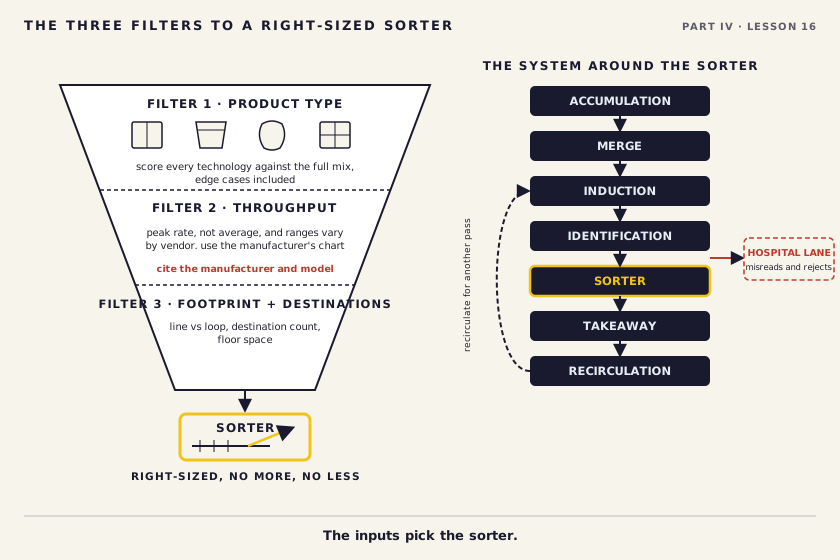
Right-sizing is the discipline between them. It isn't a feel. It's a set of inputs run in a fixed order.
Use peak, not average. A sorter sized for the average saturates on every wave.
The real rate sits below the spec sheet. Once you factor in the gap each item needs and the identification system's cycle time, a sorter rated at 5,000 pieces per hour can deliver closer to 3,800. Select on the effective rate.
No universal scale. There's no single industry-standard scale that sorts every sorter into slow, medium, and high by fixed numbers. Compare using the manufacturer's published rate chart for the specific equipment, and cite the model.
Selecting on average throughput. The system has to perform at peak, and a sorter chosen for the average will fail during every wave release and every high-volume period. Pull the peak from the flow diagram and select to that, then give it headroom, because the effective rate sits below the published maximum once the gap and the scan-tunnel cycle time are in the picture.
Line sorter. Fed at one end, sorts off to the sides. Product gets one pass, so it needs a separate recirculation conveyor for missed sorts and lanes that weren't ready.
Loop sorter. Fed from the side, often at several points, with recirculation built in. Cross-belt, tilt-tray, and bomb-bay are loop; the others are generally line.
A sorter that clears throughput and product but can't fit its destinations in the space you have is the wrong sorter, full stop.
Engineers over-engineer or under-engineer the sorter all the time. Right-sizing it takes time, calculation, and a full understanding of the material to be handled and the system requirements. You can't skip the product analysis, you can't skip the peak throughput calculation, and you can't assume a sorter that worked on the last project works on this one. Let the inputs pick the sorter. Don't pick the sorter and then justify it.

Run the three filters in order. Filter one: read the matrix against the full mix, not just the Standard Case at 78 percent, the tippy Tall Case and the big heavy Large Case included. Filter two: Dana's target of 20 cartons per minute is 1,200 pieces per hour, a low rate for automated equipment, so throughput won't eliminate anybody. Filter three: three doors is a modest destination count, and the building gives you room, which keeps a line sorter in play. Name the technology and write the justification, and every technology you ruled out and why. Date it.
A sorter has to fire the right divert at the instant the right carton is over it, and it can't do that by guessing where anything is. The encoder is how it knows. It tracks the belt's movement precisely, so the controls system always knows how far every identified carton has traveled since it was scanned, and it fires each divert when that carton reaches its destination, not early and not late. That's also why the identification cycle time and the gap are throughput constraints: the system needs time and room to read, decide, track, and divert each item on its own.
Next: When is conveyor the right answer, and when is it the wrong one?