A sorter doesn't sort by itself, so before you pick one, take three ideas from the controls side, kept shallow because the deep controls arc is Part V. First, the handshake: the identification system reads a package, asks where it goes, gets an answer back, and the PLC fires the divert at the instant that package is over its destination. That request and answer is a timed handshake, and its timing limits how fast the line can run.
Second, lane-full: a takeaway lane can fill up, and the system has to know so it doesn't divert into a lane with nowhere to put the carton, which is where recirculation and the hospital lane come in. All of that costs time and needs a gap, so the read, the decision, and the divert are throughput constraints, not free. The full three-part handshake is Lesson 22, and the lane-full and hospital-lane recovery logic is Lesson 23. Here you're naming the concepts, not building them.
By the end of this lesson you should be able to run the three selection filters in order, product first, then throughput, then footprint and destinations, read a product handling matrix against your full mix instead of your majority product, use peak rate and not average as the selection input, and design the system around the sorter, with the recirculation path and the hospital lane included, not just the sorter itself.
There are two ways new engineers get sorter selection wrong, and they point in opposite directions. Over-engineering: you reach for a high-throughput, high-capability sorter an application never needed, and you spend the customer's capital on capability nobody uses. Under-engineering: you pick a sorter that can't handle the product mix or the peak rate, and you build a system that fails the first time the floor gets real. Both are expensive, both avoidable. Right-sizing is the discipline between them, and it isn't a feel you develop. It's a set of inputs run in a fixed order.
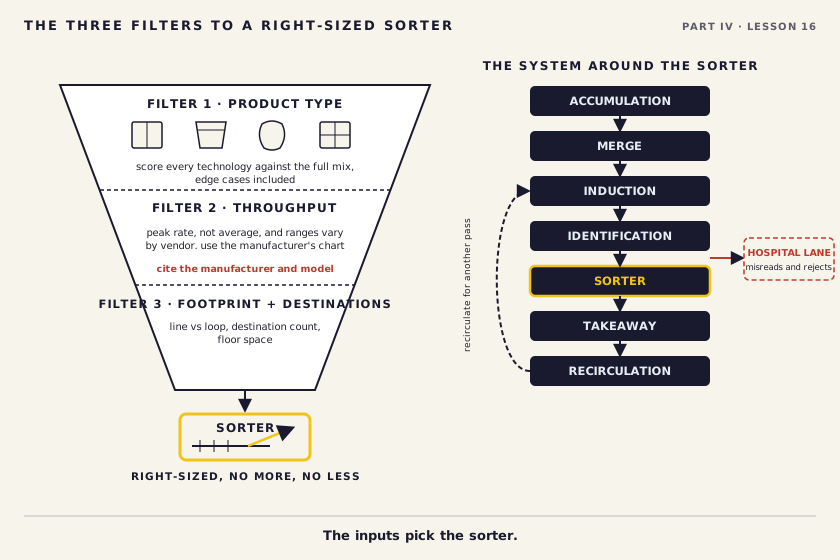
Product type is the first filter, because it decides which mechanisms can touch your product without wrecking it. Dimension, weight, shape, rigidity, packaging, and surface all matter. A sliding-shoe sorter that's excellent for corrugated cartons can be a poor choice for bagged apparel. And your mix is almost never one product type, so the sorter has to survive the whole range, edge cases included, not just the product you see most. Score the technologies against the full mix first, keep the ones that clear every product in it, then move to throughput. A technology that clears the majority but chews up the edge case isn't a candidate. It's a jam waiting for a wave.
The Hytrol product handling matrix rates technologies against product categories as excellent, good, fair, poor, or not applicable. Here's the summarized form the Hytrol Sortation Technology white paper uses. Read down a column for a product, across a row for a technology.
| Sorter technology | Corr. carton | Plastic tote | Bagged apparel | Parcel | Large parcel |
|---|---|---|---|---|---|
| Pusher (N-Line) | Excellent | Excellent | Poor | Poor | N/A |
| Narrow Belt 90 Deg (N-Line) | Good | Good | Poor | Poor | Poor |
| Belted Pivot Wheel (M-Line) | Good | Good | Poor | Good | N/A |
| Narrow Belt 30 Deg (M-Line) | Good | Good | Poor | Poor | N/A |
| High Density Sliding Shoe | Fair | Fair | Excellent | Excellent | N/A |
| Sliding Shoe (M-Line) | Excellent | Excellent | Good | Fair | Poor |
| Sliding Shoe Very Large (M-Line) | Excellent | Excellent | Fair | Good | Excellent |
| Tilt Tray (Loop) | Excellent | Good | Fair | Fair | Poor |
| Cross Belt (Loop) | Excellent | Fair | Excellent | Excellent | Poor |
Source: Hytrol Sortation Technology white paper, as summarized in the module. The matrix is a starting point for selection, not a final answer; it gets applied against the specific application inputs.
No row is excellent everywhere, and that's the point: the minority product picks the fight, so you read the matrix against your mix, not your majority, and the technology has to win against the edge case before throughput ever enters the picture.
Specialty handling for garments on hangers, tires, and other odd-shaped product families is its own category, and it's Lesson 17. This matrix covers cartons, totes, bags, and parcels. If your mix carries a specialty product, name it and carry it forward. Don't force it onto a carton sorter.
If you're evaluating sorters against a mixed product set, then score every technology against the edge-case products in the mix, not just the majority, before you look at throughput at all. Tradeoff: it slows the first cut down and it can eliminate a technology you liked. Verify: if a technology scores poor on even a minority product that has to go through this sorter, it's out. A sorter that's excellent for 85 percent of the mix and destroys the other 15 isn't a right-sized sorter. It's a future field problem with good paperwork.
Throughput is the second filter, run only against the technologies that survived filter one. Two rules do the work. First, use the peak rate from your flow diagram, not the average, because a sorter sized for the average saturates on every wave. Second, the rate you'll actually get sits below the spec sheet: once you factor in the gap each item needs and the identification system's cycle time, a sorter rated at 5,000 pieces per hour can deliver closer to 3,800. Select on the effective rate.
On the ranges themselves, a lot of training material gets this wrong. There's no single industry-standard scale that sorts every sorter into slow, medium, and high by fixed numbers; those boundaries vary by vendor and product mix. Compare using the manufacturer's published rate chart for the specific equipment, and cite the manufacturer and model whenever you quote a number. As a source-anchored guide, not a universal scale, here's what the published charts support.
| Band | Rough rate | Representative technologies |
|---|---|---|
| Entry-level automated | ~3,000 to 6,000 pph | Pushers, MDR diverts, strip-belt transfers |
| Mid-range | ~5,000 to 10,000 pph | Pop-up wheel and sweeper sorters |
| High-throughput | ~7,000-8,000 up to 27,000-30,000+ pph | Sliding shoe, tilt-tray, cross-belt; highest multi-tray configs exceed 30,000 |
Source: Honeywell Intelligrated, "Sorting Out Your Sortation Options," 2020. Boundaries overlap and vary by vendor; treat this as a guide, then confirm against the manufacturer's chart for the specific model.
Keep one number straight: manual, non-automated sorting is what sits near or below 1,800 pieces per hour, people reading labels and walking cartons by hand, not a slow automated sorter. Don't use 1,800 as the benchmark for slow automated equipment, since the entry-level automated technologies start around 3,000. And when you quote a single number, anchor it to a specific manufacturer and model from that vendor's published rate chart, not to a generic slow-medium-high label.
Selecting on average throughput. The system has to perform at peak, and a sorter chosen for the average will fail during every wave release and every high-volume period. Pull the peak from the flow diagram and select to that, then give it headroom, because the effective rate sits below the published maximum once the gap and the scan-tunnel cycle time are in the picture.
The arithmetic that proves a specific sorter clears a specific rate, the cartons per minute, the speed gap ratio (SGR), the required sorter speed, and the model-minimum and geometric gap checks, is final engineering. It's Lesson 25, and the Calc Logic Guide is its authority. Here you select a technology from ranges and peak rate. You don't run the gap check.
The third filter is physical: how much floor you have and how many destinations you serve. A line sorter is fed at one end and sorts off to the sides, and because product gets one pass, it needs a separate recirculation conveyor for missed sorts and lanes that weren't ready. A loop sorter is fed from the side, often at several points, and carries recirculation built in, so a carton that misses just rides around and tries again. Cross-belt, tilt-tray, and bomb-bay are loop; the others are generally line. Destination count sets the length, and the layout has to settle the takeaway spacing and lane widths before you confirm a footprint. A sorter that clears throughput and product but can't fit its destinations in the space you have is the wrong sorter, full stop.
Two sorters both handle your product mix and both clear your peak rate. One's a line sorter, one's a loop. You've got a tight floor and a lot of destinations. Before you look at price, ask: which one needs a separate recirculation conveyor, and where does a missed sort or a full lane actually go on each? What does that do to the footprint you were trying to save?
Here's the classic miss: designing the sorter and forgetting the system it lives in. A complete line sortation system is a sequence, and every element does a job the sorter depends on. In order.
The recirculation path isn't an afterthought. Leave it out of a line sortation system and every missed sort and misread piles up at the end of the sorter until the line stops. Draw it at the flow-diagram phase, next to the sorter. The hospital lane is named here for the same reason, and how you size it is Lesson 23.
Engineers over-engineer or under-engineer the sorter all the time. Right-sizing it takes time, calculation, and a full understanding of the material to be handled and the system requirements. You can't skip the product analysis, you can't skip the peak throughput calculation, and you can't assume a sorter that worked on the last project works on this one. Every application is different, and the selection has to be driven by the specific inputs of this application: the full product mix, the peak from the flow diagram, and the footprint from the layout. Let the inputs pick the sorter. Don't pick the sorter and then justify it.

You carry in Riverside's singulated stream from the Lesson 15 merge, and now you pick the sorter that stream feeds. Here's what Dana told you, in her words.
"Our current peak is 18 cartons per minute across all three doors combined. I want the new system designed for 20 cartons per minute. That gives us headroom for the growth I am projecting over the next three years."
"Volume split at the doors. Carrier A at Door 1 gets about 55 percent of our outbound volume. Carrier B at Door 2 gets 35 percent. Door 3 is the remaining 10 percent."
"I want a system that reads the barcode on each carton, knows which carrier it belongs to, and routes it to the right door automatically. I want my associates focused on packing and loading, not on sorting."
| Product | L | W | H | Weight | % Vol | Product use |
|---|---|---|---|---|---|---|
| Small Case | 8" | 6" | 4" | 3 lbs | 4% | Packaged food |
| Standard Case | 13" | 9" | 3" | 12 lbs | 78% | All clients |
| Tall Case | 10" | 8" | 14" | 18 lbs | 12% | Apparel client |
| Large Case | 22" | 15" | 7" | 28 lbs | 6% | Housewares |
Run the three filters in order. Filter one, product type: read the matrix against the full mix, not just the Standard Case at 78 percent. Three of the four products are corrugated cartons; the Tall Case is the apparel client's box, 10 by 8 on a 14-inch height, and the Large Case is 22 by 15 by 7 at 28 pounds. Your surviving technologies have to clear all four, the tippy tall one and the big heavy one included.
Filter two, throughput: Dana's target of 20 cartons per minute is 1,200 pieces per hour, a low rate for automated equipment, since entry-level automated sortation starts around 3,000 pph. Throughput won't eliminate anybody; it just means you don't reach for a high-throughput loop to move 1,200 an hour. Confirm against the manufacturer's chart, and use peak, not average.
Filter three, footprint and destinations: three doors is a modest destination count, and a 50,000 square foot single-level building with a 28-foot clear height gives you room, which keeps a line sorter in play and doesn't force a loop. Then tie it to Dana's misdirect problem: she runs a three percent misdirect rate today with hand sorting, and your automated sorter will still throw exceptions, a barcode that won't read or a lane that's momentarily full. Note where recirculation and the hospital lane land for those so a misread carton has a path instead of stacking at the dock. Don't size them, that's Lesson 23, and don't run the rate arithmetic, that's Lesson 25.
Right-size Riverside's sorter. Run all three filters, name the technology, and write the justification into your Riverside note: the matrix evaluation and every technology you ruled out and why. Date it. Michael's going to ask why you chose what you chose. So will Dana. Make the reasoning good enough to answer them.
Part IV has been building one system in steel, and this lesson converges on the most consequential selection in the part: the sorter. Everything upstream feeds it, and everything Dana's paying for runs through it. The discipline that gets it right isn't sophistication, it's restraint: the full product mix, the peak rate, and the footprint, run in order, plus the honest admission that the ranges vary and you cite the model. Get it right and the sorter disappears into a system that just works. Get it wrong and you've either wasted the customer's capital or handed them a system that fails under its first wave. Next lesson asks the question sitting under all of it: should Riverside even be conveyor at all?
A sorter has to fire the right divert at the instant the right carton is over it, and it can't do that by guessing where anything is. The encoder is how it knows. An encoder tracks the belt's movement precisely, so the controls system always knows how far every identified carton has traveled since it was scanned, and it fires each divert when that carton reaches its destination, not early and not late. The scan happens at one point and the divert somewhere downstream, and the encoder ties that read at point A to the action at point B on a moving line. That's also why the identification cycle time and the gap are throughput constraints: the system needs time and room to read, decide, track, and divert each item on its own. How the encoder counts and how the read-decide-divert handshake is built is Part V, Lesson 22. For now, the encoder is the sorter's sense of where everything is.