Part IV. Lesson 17. The Automation Landscape.
You just spent a whole part designing conveyor. You sized the accumulation, turned the layout, merged the flows, and picked the sorter. Now here's the uncomfortable move that separates a solutions professional from a conveyor salesperson. You ask whether conveyor was even the right tool.
The standard this program holds is the elegant, simple solution: the minimum system that solves the real problem cleanly and nothing more.
The same five-percent-versus-twenty-percent judgment from Part II. Ask what percentage of the volume the specialty item is before you design anything around it: an exception path, or a different system entirely.
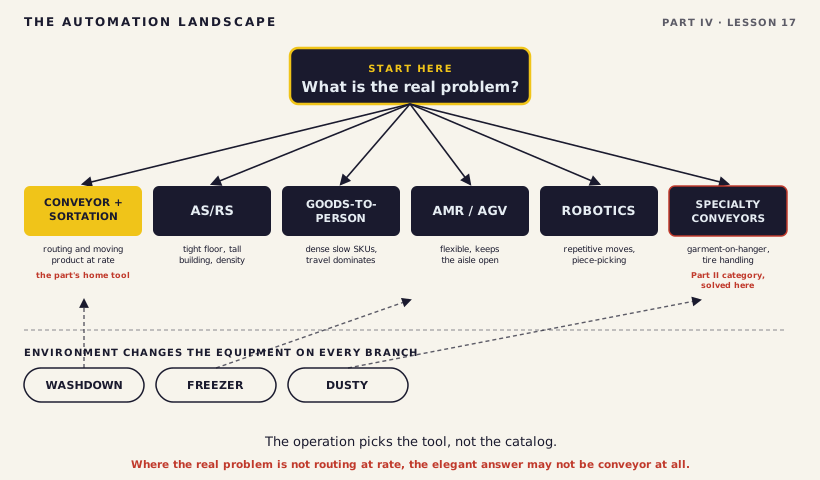
Treating the environment as a footnote. A system spec'd for a clean dry warehouse and dropped into a washdown food line, or a freezer, or a dusty operation, degrades fast, because the materials, the lubrication, and the mechanisms were never chosen for that building. The environment is a selection driver on the same level as the product and the rate. Ask about it early, and let it eliminate technologies before you get attached to one.
There are operations where conveyor is the wrong tool, and a solutions professional has to name them out loud: low volume that doesn't justify a fixed line of steel, dense slow-moving SKUs where a goods-to-person grid beats a pick-and-conveyor line cleanly, a footprint too tight for conveyor but tall enough for storage-and-retrieval, a product the standard mechanisms fight, or a flexibility requirement fixed steel can't meet.
Put the alternative categories on the table, and let the operation choose, not the catalog.
Matching the technology to the maintenance reality and the environment is as important as matching it to the product. And here's the part new engineers miss. Sometimes the right answer isn't a conveyor at all. Where there's real density and slow-moving SKUs and not much floor, a goods-to-person system can beat a pick-and-conveyor line cleanly. I love finding the elegant, simple solution to a complicated problem. Not the most sophisticated one. The minimum one that actually solves it. Sometimes that's my conveyor. Sometimes it's honest to say it's not.

Step all the way back from the conveyor system you built across this part and ask the honest question. Should Riverside even be conveyor? Riverside's problem is outbound sorting to three doors at a design target of 20 cartons per minute, with a manual misdirect problem near three percent, a mezzanine feed, and a maintenance team of one. Is this a storage-density problem an AS/RS solves? A dense, slow-moving pick problem a goods-to-person grid solves? Or is it sortation and routing at the dock, which is what conveyor and sortation are for? Name the alternatives you considered, say why conveyor fits, and name what would have changed the answer.
The alternatives don't plug into your conveyor PLC the way a conveyor does. An AS/RS runs on its own warehouse-control layer that manages storage locations and retrieval sequencing. A goods-to-person grid has a controller that runs the grid and the ports. An AMR fleet runs on a fleet manager that routes and deconflicts robots in real time. Each platform brings its own control brain, and your job at the boundary is the interface, what information has to pass between your system and theirs, not programming their internals. That's the whole reason Part V exists.
Next: Which layer of the system owns this decision?