You just spent a whole part designing conveyor. You sized the accumulation, turned the layout, merged the flows, and picked the sorter. Now here's the uncomfortable move that separates a solutions professional from a conveyor salesperson. You ask whether conveyor was even the right tool.
The standard this program holds is the elegant, simple solution: the minimum system that solves the real problem cleanly and nothing more. Sometimes that isn't a line of steel across the floor. Systems thinking means zooming out far enough to see the whole operation at once, and that view sometimes points away from conveyor. Asking this late is uncomfortable. Never asking it is how engineers oversell and underserve. So we ask it now, before the part closes.
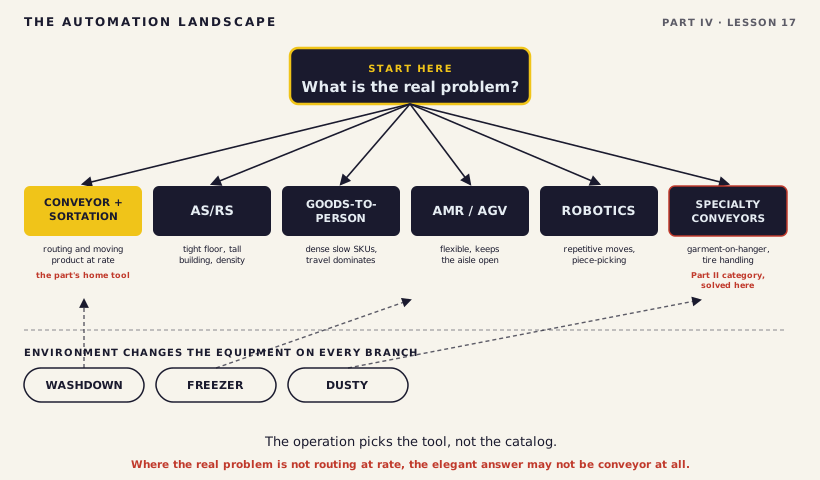
By the end of this lesson you should be able to place conveyor inside the full automation landscape, recognize the categories that replace or complement it, AS/RS, goods-to-person, AMRs, robotics, and the specialty conveyors, know that different environments change the equipment, and say out loud, before you draw a line, when the elegant answer to the customer's problem isn't conveyor at all.
Conveyor is one tool on a floor full of them. Each of the others is a category with an operation it fits, not a product to sell. Learn what each one is for, and you learn where conveyor stops being the answer.
Not every alternative is a clean break from the world you just left. The loop sorters you met selecting the Riverside sorter, cross-belt and tilt-tray, sit at the edge of the conveyor world. Cross-belt handles parcels and irregulars that a standard bed and many line sorters fight. When the mix drifts toward parcels and irregulars, you're already moving toward the specialty and platform end of the floor.
Here's the rule from Lesson 7, come back to collect. When the operation is really one of these platforms, the manufacturer's own sizing tool is the authority, not the conveyor calculator. Name the platform early and get the right tool before engineering starts. The grid, port, and cycle-time math belongs to the vendor who builds the grid. Your job is to recognize which platform the operation actually is. And watch the seam where your steel meets their grid: your conveyor calc sizes the conveyor side of that handoff and the OEM tool sizes the storage-and-retrieval side, and the two only meet if both are built around the exact same container spec, the same tote or carton. Let those specs drift apart and the system fails right at the handoff, so lock the shared container spec and hold both tools to it. These platforms differ in total installed cost and service life, and those differences decide between them, but running that comparison is the business case, and it waits for Lesson 29. Here you place the categories and name the fit. You don't run the payback.
If a customer's operation has low volume, dense slow-moving SKUs, or a tight-but-tall footprint, then put the alternative categories on the table before you draw any conveyor, and get the manufacturer's sizing tool for whatever platform the operation might really be. Tradeoff: it can talk you out of the conveyor project you came in to sell. Verify: if the elegant answer to the customer's actual problem is a goods-to-person grid or an AS/RS, saying so is the job. The engineers who ask this question early are the ones customers trust with the next project.
A customer asks for a big conveyor-and-sortation system. Their volume is low, their SKUs are dense and slow-moving, and their building is short on floor but tall. Before you draw a single line, name two categories of equipment that aren't conveyor that might solve their real problem better, and say what you'd need to know to tell. No calculator. Just the judgment.
Back in Part II the program named tires, hanging garments, and irregular items as the specialty-handling category. It said their presence changes the system architecture, and it deferred their solutions. This is where that deferral gets paid. The specialty category gets its answers here.
Here's the lesson-level point. The specialty product's presence, and its share of volume, decides whether you build an exception path or a different system entirely. It's the same five-percent-versus-twenty-percent judgment from Part II, now with the solutions attached. If the specialty item is five percent of volume or less, you probably build an exception path and handle it beside the main system. If it's twenty percent, you have a different system on your hands. Ask what percentage of the volume it is before you design anything around it. A system spec'd for cartons that meets a mix nobody screened for polybags fails within a month, and that's a discovery failure before it's ever an engineering one.
The environment the system lives in is a selection driver on the same level as the product and the rate, not a footnote. It can eliminate whole technologies before you get attached to one, and it interacts with the maintenance reality you carried into this part.
How harsh environments drive reliability is Lesson 26, and the guarding and code implications are Lesson 27. Name the environment as a driver now; the compliance and reliability depth comes later. What you owe the design today is to let the building eliminate technologies before the drawing exists.
Treating the environment as a footnote. A system spec'd for a clean dry warehouse and dropped into a washdown food line, or a freezer, or a dusty operation, degrades fast, because the materials, the lubrication, and the mechanisms were never chosen for that building. The environment is a selection driver on the same level as the product and the rate. Ask about it early, and let it eliminate technologies before you get attached to one.
Put the honest close on the table. There are operations where conveyor is the wrong tool, and a solutions professional has to name them out loud: low volume that doesn't justify a fixed line of steel, dense slow-moving SKUs where a goods-to-person grid beats a pick-and-conveyor line cleanly, a footprint too tight for conveyor but tall enough for storage-and-retrieval, a product the standard mechanisms fight, or a flexibility requirement fixed steel can't meet.
The move in every one of these is the same. You put the alternative categories on the table, and you let the operation choose, not the catalog.
Matching the technology to the maintenance reality and the environment is as important as matching it to the product. A system that works perfectly at installation and degrades fast because nobody can maintain it, or because the building fights it, is a delayed failure. And here's the part new engineers miss. Sometimes the right answer isn't a conveyor at all. Where there's real density and slow-moving SKUs and not much floor, a goods-to-person system can beat a pick-and-conveyor line cleanly. Where there's no maintenance to speak of, the simpler, more durable choice wins even if it costs more up front. I love finding the elegant, simple solution to a complicated problem. Not the most sophisticated one. The minimum one that actually solves it. Sometimes that's my conveyor. Sometimes it's honest to say it's not.

Step all the way back from the conveyor system you built across this part and ask the honest question. Should Riverside even be conveyor?
Lay the facts out. Riverside's problem is outbound sorting to three doors at a design target of 20 cartons per minute, with a manual misdirect problem near three percent, a mezzanine feed, and a maintenance team of one. Now test that against the alternatives. Is this a storage-density problem an AS/RS solves? Is it a dense, slow-moving pick problem a goods-to-person grid solves? Or is it sortation and routing at the dock, which is what conveyor and sortation are for?
Write the automation-landscape review into your Riverside note. Name the alternatives you considered, say why conveyor fits Riverside, and name what would have changed the answer, much lower volume, or a dense slow-moving storage problem, or a floor too tight for the footprint. The value isn't defaulting to conveyor. It's being able to say why it's the right tool here, and meaning it.
This closes Part IV, the part where you designed the conveyance. Look at what it actually taught. Not that conveyor is always the answer, but how to build it well when it is, and how to know when it isn't. That's the forest. A professional who can design a clean conveyor system and still say, on the right operation, that conveyor isn't the elegant answer is worth more than one who reaches for steel every time. You leave this part able to place the steel inside the whole landscape, which is the only place a design decision is ever really made.
Every lesson in this part ended here, at the controls reality of the hardware, and the landscape has one too. The alternatives don't plug into your conveyor PLC the way a conveyor does. An AS/RS runs on its own warehouse-control layer that manages storage locations and retrieval sequencing. A goods-to-person grid has a controller that runs the grid and the ports. An AMR fleet runs on a fleet manager that routes and deconflicts robots in real time. Each platform brings its own control brain, and your job at the boundary is the interface, what information has to pass between your system and theirs, not programming their internals. That's the whole reason Part V exists: the five layers of controls, the handshakes, and the ownership of who decides what. You've spent this part learning what the steel does. Part V is where you learn how the whole system knows what to do, across every platform in the building, conveyor and not.