Part V. Lesson 18. Control Philosophy.
A running system starts sending a slice of its cartons to the wrong doors. The controls contractor swears the PLC is clean. The mechanical team shows you the divert firing on time. IT proves the WMS is sending correct routing. Three teams, each certain the problem isn't theirs, and the misdirects keep going out the door.
Nobody has named which layer owns the problem.
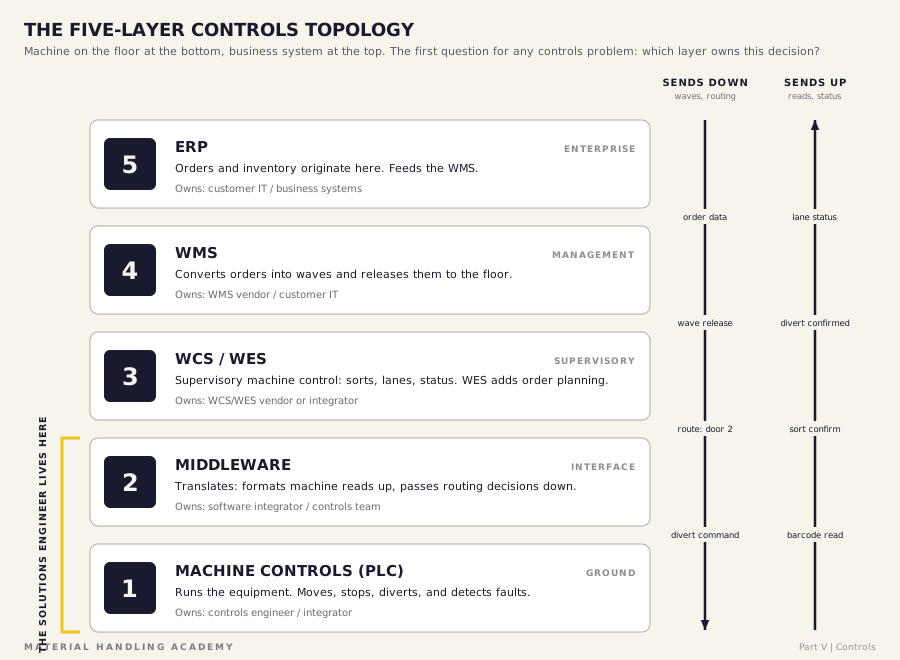
Instructions move down, status moves up. Your home is the bottom two layers.
You have to understand all five well enough to hold an intelligent conversation with every person on the project, from the PLC programmer to the WMS administrator to the customer's IT director. Nobody's an expert at all five, and you don't need to be.
But your working knowledge runs deepest at Layers 1 and 2, where the conveyor you designed connects to the machine controls and the data-exchange interface. That's your home. That's why the gold bracket sits exactly there.
Supervisory control of the machines. Sort decisions, lane assignments, system status. It routes what the WMS tells it to route.
A WCS that also does order-side work. Order planning, batching, sequencing. It decides some of the order logic itself.
The boundary is order intelligence. Same box on the floor, different line of responsibility. Ask what the system decides, not what it's called.
Treating WCS and WES as interchangeable because the acronyms look alike. They're not the same layer of responsibility. A WES makes order-side decisions a WCS never touches. Spec a plain WCS into an operation that needed order execution and you've left a whole layer of decisions with no owner, and the customer finds out during the first peak.
| The decision | Layer that owns it |
|---|---|
| Release this wave to the floor | WMS, Layer 4 |
| Divert this carton to lane 5 | WCS decides, L3; PLC executes, L1 |
| Stop this zone, it's jammed | PLC, local logic, Layer 1 |
| Format the read so the WMS can use it | Middleware, Layer 2 |
If you're walking into a controls problem on a live system, then before you dispatch anyone, draw the five layers on whatever's nearby and ask one question at each: is the read good, is the translation good, is the destination returned correct, is the wave current. Verify: the layer where your questions stop getting clean answers is the layer that owns the problem.
"We run a standard WMS. It manages all picking, inventory, and order release. When an order wave goes out the WMS knows which carrier each carton is going to. That information is tied to the barcode on each carton."
Place every piece of Riverside on the five layers, owner named next to each. Then flag the one open item: Ray's WMS response-time number, half a second, unconfirmed. It sits at the Layer 2 / Layer 3 boundary, and the architecture can't be finalized until Ray confirms it. Don't run the math yet. Mark it and date it.
Next: How does the system know what a package is and where it is?