MATERIAL HANDLING ACADEMY

Part V. Lesson 19. Sensing and Identification.

DRIVING QUESTION How does the system know what a package is and where it is?
PART V | LESSON 19: SENSING AND IDENTIFICATION

Every Decision Starts With a Read

The whole controls stack exists to make decisions. Sort this carton to Door 1. Hold that one. Reject the overweight one. Every decision runs on information, and the information comes from one place: the sensing layer, where the system actually reads the world.

A decision is only as good as the read it's made from.

PART V | LESSON 19: SENSING AND IDENTIFICATION

Two Jobs of the Photoeye

Presence

Is there a package here, yes or no. A steady-state question the eye answers for as long as the package sits in front of it. This is the transducer that reports to an accumulation zone.

Registration

Exactly when a leading edge crosses one fixed point. An event, a single instant. Every timed action in a section, the scan, the tracking clock, the divert, hangs off a registration read.

PART V | LESSON 19: SENSING AND IDENTIFICATION

The Rule You Never Break

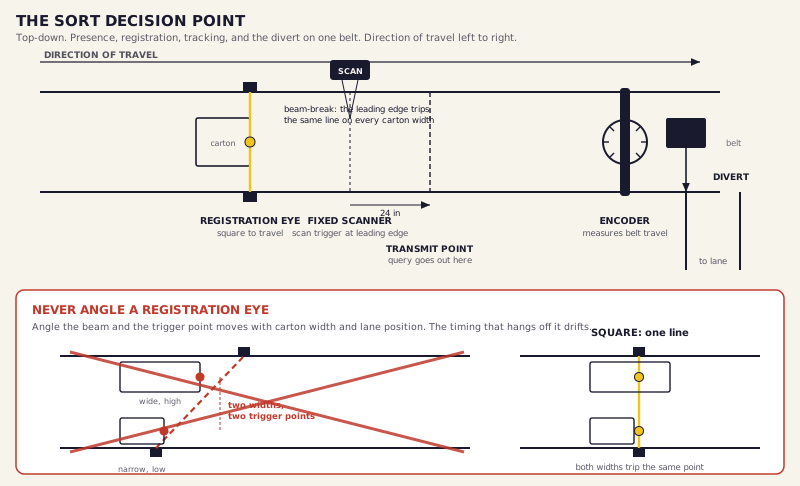
A photoeye used for registration has to be mounted square to the direction of travel. Square, the leading edge breaks the beam at the same repeatable point on every carton, no matter where it rides across the belt.

Angle it and you trade a repeatable trigger for a variable one.

An angled eye can look like it catches more of the box. For registration that's exactly backwards.

PART V | LESSON 19: SENSING AND IDENTIFICATION
Top-down view of a sort decision point. A carton moves left to right past a registration photoeye mounted square across the belt, its beam-break point marked in gold. Downstream a fixed barcode scanner triggers at the carton's leading edge, and a transmit point is marked 24 inches downstream. Further on, a sorter with an encoder wheel on its drive shaft fires a divert into a lane. A crossed-out inset shows the same eye mounted at an angle.
One belt, four jobs: presence and registration at the eye, identification at the scanner, position tracking by the encoder, and the divert.
PART V | LESSON 19: SENSING AND IDENTIFICATION

The Encoder

A read happens at one fixed point. The divert happens well downstream. In between, nothing watches that specific carton. The encoder closes the gap: it measures belt travel in precise increments, and the PLC uses that measurement to know exactly where every item is at any moment.

The carton stops being a thing to watch and becomes a number, a position counted forward from induction. Same principle a CNC machine or an industrial robot runs on. But tracking doesn't fix a bad read. It commits to it.

PART V | LESSON 19: SENSING AND IDENTIFICATION

The Read Is a Family

PART V | LESSON 19: SENSING AND IDENTIFICATION
COMMON MISTAKE

Designing as if every barcode reads. It never happens. Damaged labels, bad orientation, poor print, and shrink-wrap glare all produce no-reads, and if you didn't plan a destination for the ones that fail, the first no-read of the shift is a carton sitting at a decision point with nowhere to go and a line backing up behind it. Design for the no-read rate. It's a number, not a hope.

PART V | LESSON 19: SENSING AND IDENTIFICATION
FIELD INSIGHT | MICHAEL COLLINS

I've watched a brand-new engineer angle a registration photoeye across the belt because it looked like it grabbed more of the box. Every timing in that section started drifting, and nobody could figure out why the sorter kept missing by a lane. A registration eye has to be square to travel. It's the plainest decision on the drawing, and it decides whether the whole section keeps time.

Michael Collins
PART V | LESSON 19: SENSING AND IDENTIFICATION

Riverside

RIVERSIDE PROJECT

"When an order wave goes out the WMS knows which carrier each carton is going to. That information is tied to the barcode on each carton."

The carrier lives on the barcode, so the device list at the sort point is fixed: a registration photoeye square to travel, a barcode read to pull the carrier, and the sorter encoder to carry each carton from read to divert. Make the single-scanner-versus-tunnel call from label orientation, not cost. Name the no-read destination. Mark the one thing you can't lock yet: exactly where the scan point sits. That comes back.

Next: How does a decision become motion the machine can execute safely?