PART V | LESSON 19: SENSING AND IDENTIFICATIONMATERIAL HANDLING ACADEMY
DRIVING QUESTIONHow does the system know what a package is and where it is?
EVERY DECISION STARTS WITH A READ
The whole controls stack you mapped in Lesson 18 exists to make decisions. Sort this carton to Door 1. Hold that one in the accumulation zone. Reject the overweight one. Every decision runs on information, and the information comes from one place: the sensing layer, down at the bottom of the stack, where the system actually reads the world.
Here's the part that catches people. A decision is only as good as the read it's made from, and a bad read doesn't announce itself. If the read is wrong, every layer above it acts on the wrong information, correctly and fast, and sends the carton exactly where the bad data said to. The system doesn't hesitate on a bad read. It commits. It's built to.
So the sensing layer, the least glamorous part of the whole stack, is where the accuracy of the entire system gets set. Get the read right and everything downstream has a chance. Get it wrong and you've built a fast machine for making the same mistake every time, and doing it with total confidence.
By the end of this lesson you should be able to place a registration photoeye so its read repeats, explain how an encoder tracks a carton's position from the read all the way to the divert, choose among a scanner, a scan tunnel, a camera, a scale, and a dimensioner by what each one actually reads, and design for the no-read rate instead of hoping for perfect reads.
Photoeyes: presence, registration, and the rule you never break
The photoeye is the workhorse of the sensing layer. A beam of light crosses the conveyor to a receiver. Break the beam and the sensor changes state. Simple part, and it does two different jobs that people constantly blur together.
The first job is presence. Is there a package here, yes or no. That's the transducer you met back in Lesson 12: a photoeye plugged into an accumulation zone, reporting to the zone controller so the zone knows whether to hold product or release it. Presence is a steady-state question, and the eye answers it for as long as the package sits in front of it. Presence has its own mounting trap, though: set the beam height and angle to catch the shortest, flattest carton in the mix, not the tall one you're picturing, because a beam that rides over a three-inch pad reads an empty zone that isn't. And watch reflective, shiny surfaces, shrink-wrap, foil, a glossy tote, since they can bounce the beam back and false-trigger on a package that isn't there or read the wrong one.
The second job is registration. Not whether a package is present, but exactly when its leading edge crosses one fixed point. Registration is an event, a single instant, and that instant is what starts things: a scan, a tracking clock, a timed divert. Every timed action in a section hangs off a registration read.
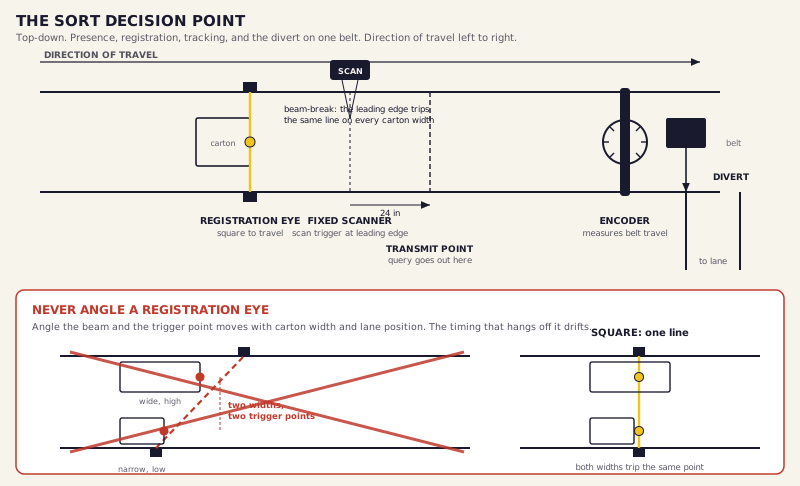
Those two jobs put different demands on how you mount the eye, and that's where the one rule in this lesson lives, the one you don't get to break. A photoeye used for registration has to be mounted square to the direction of travel. Square, the leading edge breaks the beam at the same repeatable point on every carton, no matter where the carton rides across the belt. A narrow box hugging the left rail and a wide box centered on the belt both trip the beam at the same line across the conveyor, because the beam is that line.
Angle the eye and you lose that. Now the point where the leading edge breaks the beam depends on how wide the carton is and where it sits across the belt. Two cartons cross the same physical line and trip the eye at two different instants. The registration point drifts, and every timing that hangs off it drifts right along with it. An angled eye can look like it catches more of the box, more coverage, but for registration that's exactly backwards. It trades a repeatable trigger for a variable one.
WHYRegistration is what every timed action hangs off: the scan trigger, the tracking clock, the timed divert. The read has to happen at the same point on every carton or every timing downstream inherits the error. Square to travel is what makes the trigger point repeatable.
WHENAny time a photoeye's job is to mark when a leading edge crosses a point, not just whether a package is present. Registration reads, scan triggers, and induction timing all qualify. Not when: Don't angle a registration photoeye to catch more carton. The angle feels like coverage and it's the opposite. It turns one repeatable trigger point into a moving one that shifts with carton width and lane position, and you've traded your timing reference for a guess.
WHEREAt the scan point, at induction, and anywhere a timed action starts from a leading-edge detection.
FAILURE IF IGNOREDThe registration point drifts a little on every carton, so the scan fires a little early or late, the tracking clock starts from the wrong place, and the divert misses by a hair that becomes a wrong lane. Nothing looks broken. The reads just quietly stop landing where you designed them to.
One more thing that same presence photoeye does, so you recognize it in the field. A photoeye that should clear within a set window and doesn't is reporting a jam. A lane-entry photoeye that stays blocked is reporting a full lane. Same sensor, different question. What the system does about a jam or a full lane, the recovery logic and the response it triggers, is its own subject and it's Lesson 23. Here, name the job the eye is doing and keep moving.
FIELD INSIGHT | MICHAEL COLLINS
I've watched a brand-new engineer angle a registration photoeye across the belt because it looked like it grabbed more of the box. Every timing in that section started drifting, and nobody could figure out why the sorter kept missing by a lane. A registration eye has to be square to travel. Square, the leading edge breaks the beam at the same spot every single time, no matter where the carton rides across the belt. Angle it and that spot moves with every box. It's the plainest decision on the drawing, and it decides whether the whole section keeps time.
One belt, four jobs: presence and registration at the eye, identification at the scanner, position tracking by the encoder, and the divert. The crossed-out inset is the never-angle rule.FIELD FOOTAGE | The One Rule You Never Break
The One Rule You Never Break120 to 150 secondsRecording coming
Michael's filming a registration eye square, then angled, so you can see the drift. The write-up above carries the rule meanwhile.
Encoders: knowing where the carton is after the read
A read happens at one fixed point. The divert happens somewhere downstream, a good distance later. In between, nothing is watching that specific carton. So how does the system know, at the instant the carton reaches the divert, that this is the one it scanned well upstream, and that now is the moment to fire?
The encoder. On a sorter, an encoder measures belt travel in precise increments, and the PLC uses that measurement to know exactly where every item is at any given moment. The carton stops being a thing the system has to keep an eye on and becomes a number: a position, counted forward from the point where it was inducted. The belt has moved exactly this far since the read, so this carton is exactly here now. When here lines up with the divert, the PLC fires, and it fires on time even though the read happened well upstream. The encoder is the mechanism that closes the loop between the identification event and the divert event.
This isn't a conveyor trick. It's the same position-tracking principle a CNC machine or an industrial robot runs on. The item gets treated as a virtual object moving through a coordinate system, and the machine knows the coordinate at all times. A sorter tracking a carton by belt-travel distance from induction and a robot tracking its tool through a work envelope are doing the same thing: holding a moving object as a number and trusting the number.
Here's the dependency worth saying out loud. The encoder can only trust the read if the read was repeatable. If registration drifted because somebody angled the eye, the encoder faithfully tracks a carton whose starting position was already wrong, and it diverts precisely to the wrong place. Tracking doesn't fix a bad read. It commits to it. And when the encoder loses a carton, when track drops, that carton has a destination waiting for it, the hospital lane. Naming that path is enough for now. Turning encoder counts and belt speed into the actual distance you need between the read and the divert is the latency budget, and that math is Lesson 22.
Identifying and measuring: the read is a family, not a device
Up to now I've said the read like it's one thing. It isn't. The read is a family of devices, and you pick from it by what you actually need to know at that point.
A fixed barcode scanner reads a barcode presented in a known orientation at a known point. It's the default when you can control how the label faces the reader: fast, reliable, inexpensive, as long as that orientation holds.
A scan tunnel is an array of scanners arranged to read a barcode on any of several faces at once. You spec a tunnel when you can't guarantee which way the label faces, because the product arrives however it arrives. The tunnel buys you orientation independence, and it costs more and takes more room than a single head.
A camera, or vision system, reads what a laser scanner can't. A damaged label, an unoriented one, the printed characters themselves through OCR, or the condition of the package. When the barcode alone won't carry the job, the camera picks it up.
An inline scale weighs the package while it's moving, without stopping the line, for any decision that turns on weight: a routing call, or a reject when the weight comes back outside the expected range.
A dimensioner measures length, width, and height in motion. You use it for cubing, or to confirm a package sits inside the design envelope you built the system around before it reaches equipment that assumes it does.
Now the part that separates a real design from a hopeful one. No identification system reads everything. Some share of barcodes come back unreadable: torn labels, bad print, shrink-wrap glare, a carton that landed with the label face-down. That share is the no-read rate, and it's a number, not a hope. You design for it. A read that fails has to have somewhere to go. Give it a destination, the hospital lane, and a no-read becomes a routine event the system absorbs without breaking stride. Leave it without one and the first failed read of the shift is a carton stopped at a decision point with nowhere to go, waiting for a routing answer that will never come, and the line backs up behind it. What that destination has to be sized to hold, and how the routing around it gets built, is Lesson 23. That it has to exist gets settled right here.
COMMON MISTAKE
Designing as if every barcode reads. It never happens. Damaged labels, bad orientation, poor print, and shrink-wrap glare all produce no-reads, and if you didn't plan a destination for the ones that fail, the first no-read of the shift is a carton sitting at a decision point with nowhere to go and a line backing up behind it. Design for the no-read rate. It's a number, not a hope.
STOP AND THINK
A carton with a torn label reaches your scan point and comes back no-read. Trace what happens next in a system that planned for it, and in a system that didn't. Then say which of those two systems you'd rather be standing next to during a peak wave.
PRO TIP | MC
If you can't guarantee which face the barcode presents to the scanner, then spec a scan tunnel instead of a single fixed head, and confirm the label-placement standard with the customer before you commit. Tradeoff: a tunnel costs more than a single head and needs more room and alignment. Verify: walk a sample of the customer's real cartons past the read point in the orientations they actually arrive in. If a single fixed head reads all of them reliably, you just saved the tunnel. If it doesn't, you just avoided a no-read problem you'd have owned in the field.
RIVERSIDE PROJECT
Back to Riverside. You've got one sort decision point: the spot where the system reads a carton and decides which of the three doors it goes to. Time to spec what does the reading. Here's what Ray told you in the systems meeting, word for word.
"We run a standard WMS. It manages all picking, inventory, and order release. When an order wave goes out the WMS knows which carrier each carton is going to. That information is tied to the barcode on each carton."
So the carrier lives on the barcode. That fixes your device list at the sort point. You need a registration photoeye, mounted square to travel, to mark the leading edge and start the clock. You need a barcode read to pull the carrier off the label. And you need the sorter encoder to carry each carton from the read to its divert. Riverside pins two details for you: the scan trigger fires at the carton's leading edge, and the WMS query is transmitted from a point 24 inches downstream of the scan trigger. How that query gets sent and what comes back, the data handshake, is Lesson 22. Here you're placing the devices that make the read possible.
Write the sort-point sensing plan in your Riverside note. List the three devices. Make the single-scanner-versus-scan-tunnel call and defend it from label orientation, not cost: Riverside's cartons come off two pick zones onto throw-on lines, so how sure are you which way the label faces? Name the no-read destination. And mark the one thing you can't lock yet: exactly where the scan point sits. That depends on how fast the WMS answers, and Ray's half-second is still his own unconfirmed guess. That number comes back.
FOREST THROUGH THE TREES
This is the layer everything else in Part V stands on. The machine controls in Lesson 20, the networks in Lesson 21, the data handshake in Lesson 22, the recovery in Lesson 23: every one of them acts on what the sensing layer reports. A decision is only as good as the read it's made from, and that's true all the way up the stack. Place the eye square, track the carton honestly, pick the right device for what you need to know, and design for the reads that fail. Do that and the intelligence you build on top has real ground under it. Skip it and you've automated a guess.
CHECKPOINT
An engineer mounts the registration photoeye at a slight angle across the belt, and the sorter starts missing divert timing on a share of cartons, worse on the wide ones. Explain what the angle does to a registration read, and why the widest cartons get hit hardest.
An accumulation zone occasionally reports itself empty when a low, flat carton is actually sitting right in front of its presence photoeye, and a different zone running glossy, shrink-wrapped totes keeps reporting product present when the belt is clear. Explain what's wrong with the eye's mounting in the first case and what's wrong with the beam in the second, and say what you'd check to fix each one.