Part V. Lesson 20. Machine Controls.
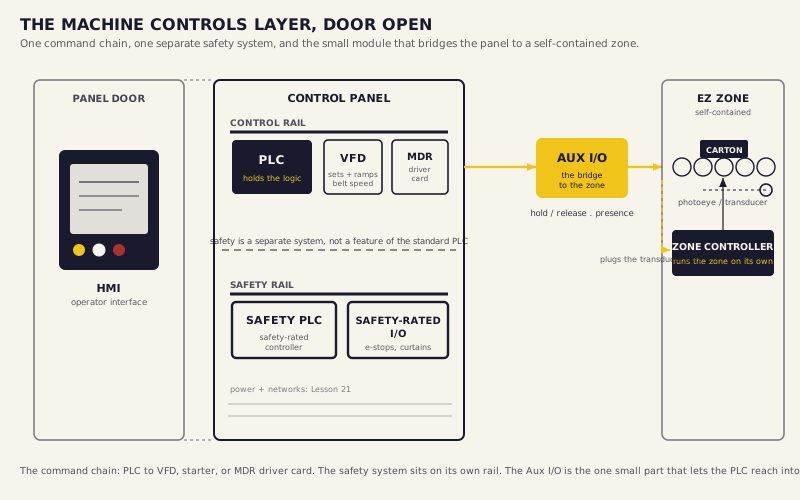
Upstream, the system already knows what the carton is and where it sits, and a layer above already decided where it goes. None of that moves a single roller. Between the decision and the motion sits the machine controls layer: the PLC, the drives, the driver cards, and a safety system that can override all of them.
Now something has to move. And it has to be safe.
Holds the logic and issues the commands. On its own it decides; it doesn't turn anything.
A VFD sets and ramps belt speed. A starter switches a fixed-speed motor. An MDR card drives an E24 zone.
A turning belt, a firing divert, a held zone. The HMI is where a person meets it all.
The self-contained EZLogic zones handle their own accumulation without the PLC touching every zone.
Keep that boundary clean and the program stays small. Blur it and the PLC ends up micromanaging every roller, which is exactly what the EZ zones were built to spare it.
The Aux I/O module plugs into a zone's transducer port on one end and the PLC panel on the other. That gives the PLC two things on a self-contained EZ conveyor: it can command that zone to hold or release, and it can read whether a package is present.
If the PLC needs to talk to the zone or listen to the zone, it needs an Aux I/O.
Map every point on paper during design. Found at commissioning, a missing Aux I/O is a panel modification at the worst possible time.
E-stops, light curtains, and interlocks run on a separate safety-rated controller and safety-rated I/O, not the standard PLC. Three ideas carry the layer.
Walk the layout and write down every zone that needs an Aux I/O: the end-of-conveyor zones feeding the sorter induction, the merge-entry zones, any zone the PLC has to hold. Confirm every accumulation zone is configured zone-stop, signal-to-release, not left at the factory default. Then start the setpoints list: belt speeds by section, the VFD ramp rate at the decline, the PLC delays at the transfers, the release mode on each zone, and the fail-safe configuration, stated.
Next: What keeps the system powered, connected, and defended?