Part V. Lesson 22. Data and Decisions.
You logged Ray's half-second WMS response as an open item and kept building on the placeholder. Then this lands in your inbox.
"Hey. Checked with our IT manager on the WMS response time question. The half second I mentioned in the meeting was best case on a normal day. Under peak load conditions the guaranteed response time is one second. That is what you should design to. Sorry I did not have the right number in the room. Let me know if you have other questions."
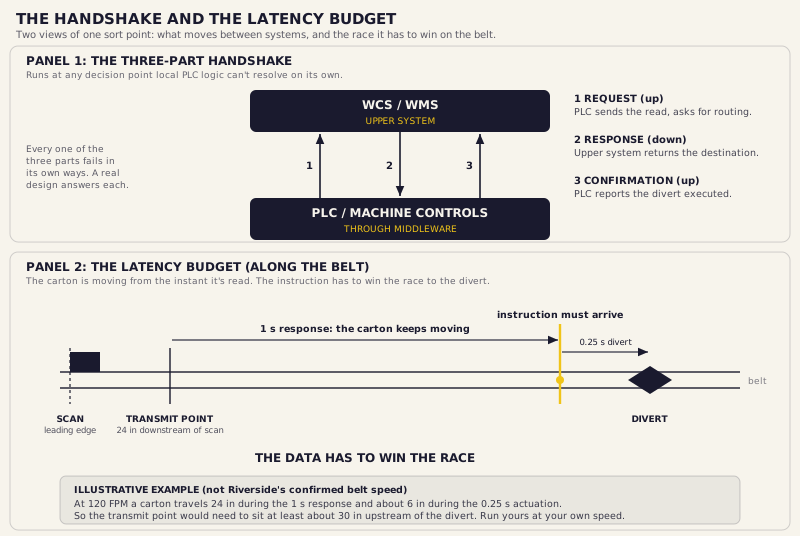
Information flow is a separate thing from product flow. The carton moves down the belt, and that's product flow. The barcode read, the routing query, and the routing answer move across the network, and that's information flow. The whole trick of a smart decision point is getting the information flow to finish before the product flow arrives at the divert. Two races run at once, and the data has to win.
The controls conversation with the customer does not focus around machine level controls. It focuses around data acquisition at each smart point in the system. What information needs to be exchanged between the system controlling the automation and the systems of the house. That is fundamentally where a solutions engineer wants to live: what information needs to be ascertained from who, at what location, so we can make the decisions in our automation.

| Part | Direction | What happens | Where it fails |
|---|---|---|---|
| 1. Request | Machine to upper system | The PLC reads the identification and sends it up through middleware with a request for routing. | No-read: the barcode's unreadable. Timeout: no answer comes back inside the window. |
| 2. Response | Upper system to machine | The WCS or WMS looks up the item, picks the destination, and returns the routing instruction. | Wrong destination returned: the item's diverted to the wrong place. Delayed response: the item's already past the point, sort missed. |
| 3. Confirmation | Machine to upper system | The PLC executes the divert and reports back that the item reached its assigned destination. | No confirmation sent: the upper system doesn't know it landed, inventory accuracy slips. False confirmation: the item jammed but the record says success. |
| Line | Value | How you get it |
|---|---|---|
| Belt speed (V) | ______ FPM | Your specified speed at the sort point. |
| Response window | 1.0 s | Ray's confirmed number, guaranteed under peak load. |
| Response distance | V x 1.0 s | How far the carton travels while the upper system answers. |
| Actuation time | 0.25 s | The divert mechanism, from the project data. |
| Actuation distance | V x 0.25 s | How far the carton travels while the divert fires. |
| Required transmit-to-divert | response + actuation distance | The minimum distance the layout has to give you. |
| Actual transmit-to-divert | ______ in | Measured on your layout, from the 24 in transmit point to the divert. |
| Fits? | actual is at least required | If it doesn't, pull one of the levers below. |
| Levers if it fails | distance / speed / gap | More scan-to-divert distance, a slower belt, or a bigger gap. All three are physical. |
Illustrative check at 120 FPM, which is 24 inches per second: response distance 24 in, actuation distance 6 in, so you'd need about 30 in from the transmit point to the divert. That figure shows the method. It isn't Riverside's confirmed belt speed.
| Link | Payload up | Payload down | Timeout | Retry | Failure behavior |
|---|---|---|---|---|---|
| PLC to WCS | The barcode read. | The door assignment. | 1 s | Your rule. | No answer in the window routes the carton to the hospital lane, the staffed exception spot where a person sorts what the system couldn't. |
| WCS to WMS | The routing query, keyed to the barcode. | The carrier-to-door instruction. | Inside the 1 s budget. | Your rule. | No destination returned is treated the same as a no-read. |
How each failure actually gets handled, the timeout out to the hospital lane, the degraded mode when the WMS is down entirely, is the exception routing, and that's Lesson 23.
Treating the response time as a software problem only. The window between scan and divert is set by belt speed and distance, and both are physical. If the upper system can't answer in that window, no amount of code speeds up a carton that's already moving. The mechanical layout has to change, and both teams own that number.
Next: When it jams, stalls, or goes dark, how does the system recover?