Same Static Angle, Two Dynamic Failures
Part VI. Lesson 24. The Perfect World Problem.
Every formula in this program produced a result for a perfect world. Rigid box presented squarely, a new belt running at exactly the commanded speed, every roller present and spinning, stable air, controlled temperature. A real installation guarantees none of it.
The calculator gave you the baseline. This part is where you prove it.
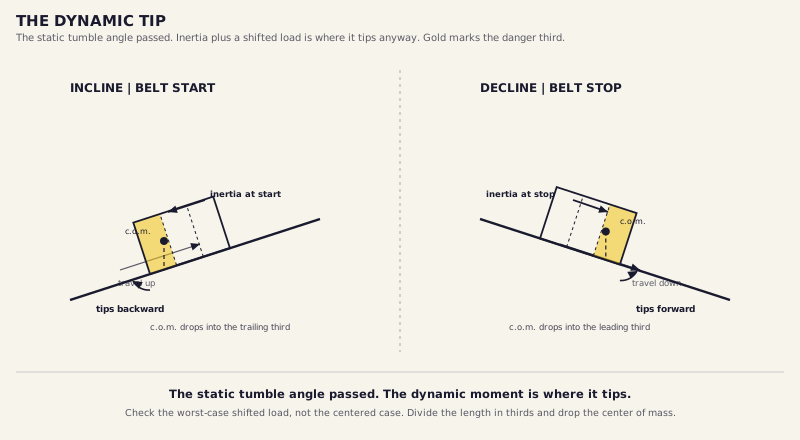
Be the carton on the decline for a second. You're riding down at a steady speed, stable, and then the belt stops. Everything inside you keeps going for a beat and piles toward your front face, and your weight goes with it, right out over your leading edge. That lurch is what the static angle never told you about. Multiply it by a load that already slid forward and that's the carton that tips.
A fifteen-minute call before the design is finalized, every time.
Treating a calculator output as guaranteed performance. Every calculation assumes ideal conditions. Real systems run in real environments with belts that slip and products that shift. A calculation that works on paper and fails in the field is an assumption that was never examined. Run the number, then ask what the number can't see.
"That mezzanine edge is going to be your challenge. Whatever comes down from up here has to land somewhere before it can go south."
The worst case is the Tall Case, 10 by 8 by 14 at 18 pounds, slowing to a stop at the bottom. Apply the thirds method to the shifted load, set the margin below the static limit, and name the two peer-review triggers. That's the first piece of the validation package.
Next: Does this system actually hit its rate, and does the gap survive every check?