Every formula in this program produced a result for a perfect world. Belt speed, gap, roller centers, incline angle, curve geometry, all of it. In that world the package is perfectly rigid and presented squarely. The belt is new, properly tensioned, and running at exactly the commanded speed. Every roller is present and spinning freely. The air is stable and the temperature is controlled.
None of those conditions are guaranteed in a real installation. Belts break in and stretch. Products arrive turned the wrong way. Rollers wear and air pressure sags. The calculation gave you the right answer for a perfect world, and this part is where you turn from designing the system to proving it. This lesson is where you decide how much margin that answer needs before it becomes a specification you sign your name to.
By the end of this lesson you should be able to take any perfect-world number off the calculator and say where the real world will bend it, name slippage, inertia, and load shift as the three that bend it most, pick the worst-case carton instead of the average to check against, tell when you're still in solutioning tolerance and when you've crossed into final engineering, and know the moments when the right move is to stop and make a fifteen-minute call.
The largest source of deviation between the paper number and the field is slippage. Belts slip against packages, worst on inclines, in acceleration zones, and as belt tension relaxes from its initial spec. Slippage means the belt moves faster than the package, so the package doesn't receive the full speed the belt is running at.
That matters because the gap you calculated assumes the package travels at belt speed. When it doesn't, the gap that actually forms between packages is smaller than the calculated gap. A gap isn't a spacing preference, it's a functional requirement the downstream equipment sets: a scan tunnel needs it to read each package cleanly, a sorter induction needs it to divert reliably. Let slippage eat the gap and that downstream equipment starts to miss.
The design response is margin. Never design to the minimum required gap. Always add buffer above it, and how much depends on the belt type, the product surface, and how critical the gap is downstream. A system designed to sit exactly at the minimum won't hold that minimum the moment any real-world variation shows up. This lesson teaches why the gap shrinks and that you carry margin into it; the gap check itself, running the produced gap against the sorter and transfer requirements, is Lesson 25.
Treating a calculator output as guaranteed performance. Every calculation assumes ideal conditions. Real systems run in real environments with belts that slip and products that shift. A calculation that works on paper and fails in the field is an assumption that was never examined. Run the number, then ask what the number can't see.
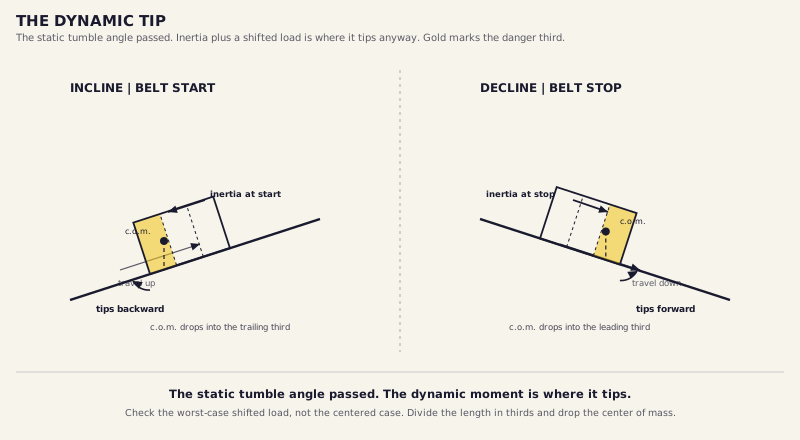
The Box Tumbling calculator gives you a static tumble angle, the angle at which a stationary package on a static incline tips under gravity alone. Two dynamic factors that the static number doesn't include drive the safe angle below that limit.
The first is inertial energy. When a belt starts or stops, the acceleration adds energy to the package that the static calc ignores. A carton that's stable at the design angle at steady speed can still tip when the belt starts from rest or stops short. The second is load shift. A carton or tote with contents that can move isn't a uniform block, so when the load slides to one end the center of mass goes with it, and a package that passed the static check with a centered load can tip with a shifted one.
Direction of travel decides where the risk concentrates. On an incline, the dangerous moment is belt start: inertia pushes the load toward the trailing edge and the package tips backward. On a decline, the dangerous moment is belt stop: inertia pushes the load toward the leading edge and the package tips forward. So you check the worst-case shifted load, not the centered case, and when the design angle sits near the limit you use the center-of-mass thirds method as a fast visual second check: draw the carton at the angle, divide its length into three, and drop the center-of-mass line to the surface. Land it in the middle third and the carton's stable. Land it in the leading or trailing third and it tips.
Be the carton on the decline for a second. You're riding down at a steady speed, stable, and then the belt stops. Everything inside you keeps going for a beat and piles toward your front face, and your weight goes with it, right out over your leading edge. That lurch is what the static angle never told you about. Multiply it by a load that already slid forward and that's the carton that tips.
One scope note before you carry this to Riverside. The decline's geometry, the angle set from the rise and the run, the belt surface, the pitch, was designed back in Lesson 14, and this lesson doesn't re-derive it. Part VI re-checks that finished geometry against the worst case under real dynamics. The design response to the inertia is a VFD ramp rate that softens the start and the stop, but the specific ramp and drive values belong to the setpoints package in Lesson 25, and the ramp time as a live PLC parameter was Lesson 20's implementation. Here you name the lever, you don't set it.
A decline conveyor passed its static tumble check with margin to spare. Name the single moment in its operating cycle when a carton is most likely to tip anyway, and say which way it tips and why. Then name the one thing about the carton's contents that would make it worse.
The same calculators run at two different stages, and the difference is precision, not the formula. In early solutioning the inputs are approximate: the average package, an estimated throughput, a rough gap. You read the outputs with a plus or minus ten percent tolerance, and the only question you're answering is whether the conveyor family is capable in this range, or whether the selection has to change before the design goes further.
In final engineering the same calculators run again with confirmed inputs: the confirmed product envelope, the finalized flow-diagram rates, gaps adjusted for slippage on the specific belt and product surface. Now the outputs stop being directional and become actual specifications, the belt speeds and gaps you install to. Confusing the two directions costs you both ways. Solutioning precision that's too tight slows the design and adds cost chasing decimals that don't matter yet. Final-engineering tolerance that's too loose ships a system that misses its targets. Part VI is the crossing. You did the solutioning back in Part III. Now you tighten every input and the numbers become specs. The tightened run itself, package basics through the sorter and transfer gap checks, is Lesson 25; this lesson names the two modes and that here's where you switch.
If speed looks like the easy way to solve a throughput problem on paper, then before you push it, ask one question: what's the real-world consequence of running this system ten percent faster than the calculated target? Tradeoff: the slower, honest number can mean a bigger conveyor or a second lane, and that costs. Verify: speed affects gap maintenance, scan reliability, transfer behavior, and incline performance in ways the calculation doesn't fully capture. Design to the answer to that question, not just to the number.
There's a norm in this industry that asking questions signals a lack of competence. The opposite is true. The most experienced engineers make manufacturer calls, pull in controls expertise, and ask peers as a standard part of every significant design, because they understand the cost of getting it wrong. It isn't a sign that they don't know the answer. It's a sign that they know what a field surprise costs.
The triggers are specific, so learn them as rules, not moods.
The rule underneath all three is one line: a fifteen-minute call to the right person before the design is finalized, every time.
Don't be afraid to call the manufacturer directly during the design phase. Call the controls engineer too. Peer review isn't a weakness, it's professional practice. The engineers who never ask for input are the ones who get surprised by field performance. A fifteen-minute call to the right person before the design is finalized is worth it every time. It isn't a sign that you don't know the answer. It's a sign that you understand the cost of getting it wrong.

Back to the mezzanine decline. When you walked the site, Michael stood you at the edge and said it plainly: "That mezzanine edge is going to be your challenge. Whatever comes down from up here has to land somewhere before it can go south." In Lesson 14 you designed that decline, 16 feet of rise, about 40 feet of horizontal run, and a decline angle every product cleared on the static tumble check. Now validate it for the real world.
The worst case here is the Tall Case, 10 by 8 by 14 at 18 pounds, a 14-inch height on an 8-inch base, coming off the second floor and slowing to a stop at the bottom. On a decline the dangerous moment is belt stop, inertia drives the load toward the leading edge, and this is a tall, narrow-based case whose apparel contents can shift forward. Apply the center-of-mass thirds method to the shifted-load case, not the centered one, and decide how much margin below the static limit the decline needs.
Then name the peer-review triggers this transition earns. Call the conveyor manufacturer about the decline belt surface and whether the calculated angle is appropriate for this product. Call the controls engineer about the VFD ramp time and whether it creates a speed mismatch with the conveyor downstream of the decline. Don't re-derive the Lesson 14 geometry, and don't set the drive values, those land in the Lesson 25 setpoints package.
Write the worst-case validation note in your Riverside file: the margin decision and the two peer-review triggers, with your reasoning. That note is the first piece of the validation package this part produces.
This is where the whole program turns. Every part before this one built the design. This part proves it, and the theme carries through all four lessons: the calculator was never the answer, judgment is. Prove it before you sign it. Slippage, inertia, and load shift are three named places the perfect-world number bends, and the fifteen-minute call is the move that catches the bend you didn't see. Learn to find where the calculated answer stops being true and you stop being the engineer who's surprised by the field. That's the difference this part is here to make.