MATERIAL HANDLING ACADEMY

Part VI. Lesson 25. The Gap Check and Capacity Proof.

DRIVING QUESTION Does this system actually hit its rate, and does the gap survive every check?
PART VI | LESSON 25: THE GAP CHECK AND CAPACITY PROOF

Now You Prove It

Lesson 24 gave the perfect-world numbers their margin. This lesson is the calc itself, run for real, inputs confirmed, your name going on the result.

Final engineering isn't more math than solutioning. It's the same math with the inputs confirmed and the tolerance pulled tight.

PART VI | LESSON 25: THE GAP CHECK AND CAPACITY PROOF

Run It In Order, or Pass the Wrong Check

PART VI | LESSON 25: THE GAP CHECK AND CAPACITY PROOF

The Sixteen Steps in Three Bands
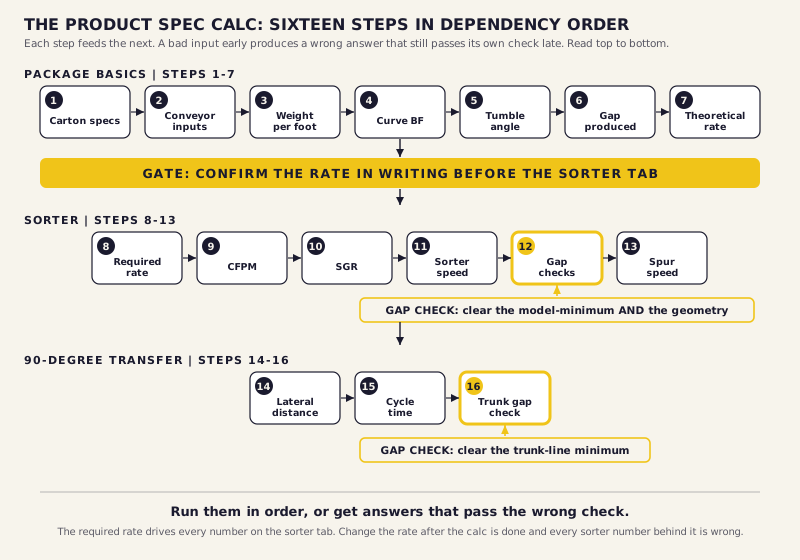
A dependency ladder of the sixteen Product Spec Calc steps in three grouped bands read top to bottom. Package basics is steps one through seven; a gold ribbon reading confirm the rate in writing sits between it and the sorter band; the sorter is steps eight through thirteen with a gold gate on the gap check step labeled clear the model-minimum and the geometry; the transfer is steps fourteen through sixteen with a second gold gate on the trunk-line gap check.
The gold ribbon is the rate-in-writing gate; the two gold gates are the gap checks.
PART VI | LESSON 25: THE GAP CHECK AND CAPACITY PROOF
COMMON MISTAKE

Running the sorter tab before the required rate is confirmed in writing. CFPM is driven entirely by rate. If the rate changes after the calc is done, every sorter number behind it's wrong, and they'll all still pass their own checks. You'll be looking at a clean tab full of numbers that answer a question the customer already moved off of. Get the rate in writing, then run the calc.

PART VI | LESSON 25: THE GAP CHECK AND CAPACITY PROOF

The Sorter Sequence

PART VI | LESSON 25: THE GAP CHECK AND CAPACITY PROOF

Worked on Riverside (20 CPM confirmed)

  1. CFPM = (20 × 20 / 12) × 1.15 = 38.3 FPM
  2. Required sorter speed = 3.2 × 38.3 = 122.6, round up to 125 FPM
  3. Gap produced = (125 × 12 / 20) - 20 = 55 in
  4. Model minimum = 9 in. 55 ≥ 9. Pass. Geometry = (15 × sin 30°) + 2 = 9.5 in. 55 ≥ 9.5. Pass.
  5. Takeaway spur = 125 / cos 30° = 144.3 FPM
PART VI | LESSON 25: THE GAP CHECK AND CAPACITY PROOF

When the Gap Check Fails: Three Levers

Name the lever before you go back to the customer. A number fixed by a lever nobody chose comes back.

PART VI | LESSON 25: THE GAP CHECK AND CAPACITY PROOF
THINK LIKE THE PACKAGE

Be the smallest carton at the sorter induction. You're short, so the gap in front of you is huge relative to your own length, and that ratio is your SGR. It's the highest in the mix, which means you're the carton that demands the fastest sorter speed. The min carton looks harmless on the spreadsheet and it governs the design at the sorter.

PART VI | LESSON 25: THE GAP CHECK AND CAPACITY PROOF

The 90-Degree Transfer and the Trunk-Line Gap

DESIGN PRINCIPLE The gap check runs every time. No exceptions.
PART VI | LESSON 25: THE GAP CHECK AND CAPACITY PROOF

Riverside

RIVERSIDE PROJECT

The rate is 20 CPM and Dana put it in writing, so the rate gate is cleared and the sorter clears both gap checks at 55 inches produced. Then the number that moves: Ray's estimate was half a second, his correction email confirms one second under peak load.

Re-run the scan-to-divert distance at the confirmed one second. A carton travels 24 inches in that window at 120 FPM, and the moment belt speed changes the gap checks change with it. Produce the capacity proof and the setpoints package.

Next: When this system fails, how fast is it back up, and can this customer keep it running?