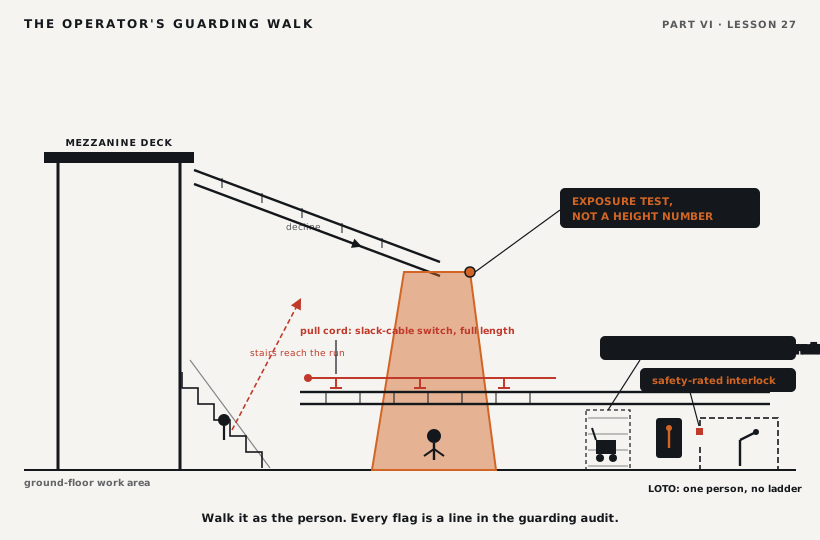
Earlier in this program you learned to act like the carton. Ride the line, feel every transfer, catch the jam before it forms. Now act like a person, specifically the person who uses this system and the person who services it. At 2 AM those are usually the same person. Walk the layout from their seat, not the carton's. Where do they stand all shift? Where do they reach in to clear a jam? Where are they when the line's down and they're the only one in the building?
Safety isn't a final-engineering item you bolt on once the design's done. It's a design discipline that starts at the first site walk. A safety item you spot during scoping costs the project nothing to add. The same item found later comes out of your margin or turns into a change order. So this lesson runs as a checklist-driven lab, and what it produces is the guarding audit: every safety item on the layout, named and priced before it becomes somebody's surprise.
By the end of this lesson you should be able to walk a layout as the person instead of the package, name the guarding categories to check on every project, decide underside guarding by exposure instead of a height number, place pull cords to the mandates that are real and the field practice that isn't, tell a safety-rated interlock from a standard switch, decide when a robot cell can run without full perimeter guarding, and hand over a guarding audit that puts every safety item in the proposal before it becomes a change order.
Before you judge any single hazard, you need the list you run every time. Five guarding categories, evaluated on every project during layout, not at final engineering:
Then walk the layout and mark which categories each section triggers. Most of them are obvious once you're looking for them. One of them gets taught wrong across the industry, so we're going to fix it here.
Here's the correction, taught straight. There's no universal height that exempts a conveyor from underside guarding. No 96-inch rule, no magic clearance that waives a belly pan. If you learned one, unlearn it now.
The governing consensus standard is ASME B20.1, the Safety Standard for Conveyors and Related Equipment. It sets the duty by exposure: spill guards, pan guards, or equivalent are required wherever falling material or components could endanger personnel below, regardless of mounting height. That's an exposure test. Can anyone be under or near the discharge or the spillage path? If they can, you guard it. How high it measures off the floor doesn't enter the decision.
Two real numbers live nearby, and neither one is a guarding exemption. ASME B20.1 sets a minimum 6 ft 8 in, that's 80 inches or 2 meters, of overhead clearance for conveyors crossing aisles, corridors, or exit routes. That's a headroom rule so a person walking under doesn't hit their head, not a reason to skip a guard. Separately, OSHA's 29 CFR 1910.219 carries a 7-foot, 84-inch threshold, but it governs exposed mechanical power-transmission parts, pulleys, shafting, sprockets, and gears. It isn't a conveyor belly-pan rule, and it's 84 inches, not 96. Don't blend those two into an exemption that neither one grants.
The staircase makes the point better than any figure can. Put an incline conveyor next to a staircase. Measured straight down to the floor, its underside looks plenty high. But a person on the stairs can reach a run that looked untouchable from the ground. The floor measurement lied. Exposure didn't.
Treating a fixed height as a guarding exemption. There's no universal height that waives underside guarding. ASME B20.1 sets the duty by exposure: guard wherever falling material or a reach-in could endanger someone below. The 6 ft 8 in figure in the standard is an overhead clearance minimum for crossing aisles, not an exemption, and OSHA's 7-foot rule is for exposed power-transmission parts, not conveyor belly pans. Guard by exposure, not by a number.
A 480V incline conveyor runs next to a staircase. Measured straight down from its underside to the floor, it's well overhead. Does that settle whether it needs underside guarding? Name the actual test, and say what the staircase changes about the answer.
A pull cord runs the full accessible length of a conveyor run and lets anyone standing along it stop the belt by pulling the cord. It's one of the most important operator safety devices on the system, and any run an operator can reach during operation or service needs one. The one real carve-out: a low-power MDR run with no diverting, lifting, or other actuation hardware, a plain 24V zone that only transports or accumulates, stores so little energy that it doesn't require a pull cord. Add a divert, a lift, or any actuation to that run and it needs one like anything else.
The work is separating what the standards actually mandate from what's just field practice, because the old training blurs them together. Mandated, under CEMA SBP-002 used with ASME B20.1: a slack-cable switch, the slack-detection kind that trips the stop if the cord is cut, broken, or goes slack, and the cord running the full accessible length. Those aren't optional. Also mandated, and numeric, but about reach and access rather than height and spacing: an E-stop actuator within 5 feet of any fixed work station, and E-stop access within 25 feet for unit handling in general-access areas, 50 feet for bulk handling.
What's not codified: the 30-to-48-inch mounting height and the 10-to-12-foot eyelet spacing you may have seen quoted as rules. They aren't ASME, OSHA, or CEMA numbers. They come from the switch manufacturer's installation instructions, commonly cable guides about every 10 feet at a consistent, reachable height, and you confirm them against that specific product's manual. Field practice, never a code mandate. Don't present them as one.
Think about E-stop zones and interlocks with the equipment around you. As a rule of thumb, if an operator can see the equipment or hear someone calling for help, the nearest E-stop should stop that conveyor as well. And when your safety interlocks tie into third-party equipment, figure out which system is the master safety system. The master should control the overall stop condition and make sure everything interconnected responds to a safety event. Getting that wrong is how you end up with one machine stopped and the one right next to it still running while somebody's reaching in.

One more thing the pull cord ties into, and here's the scope line. The cord has to stop the full zone, not just a local section. How that stop gets wired, the safety-PLC circuit behind it, belongs to the controls architecture in Lesson 20. Here you name the requirement, full zone and not a local patch. Lesson 20 owns the circuit.
A robot cell can run without full perimeter guarding, but only under one condition, and it isn't the robot's label. Retire the old cobot-versus-industrial-robot split. Safety is a property of the application and its risk assessment, not the marketing name on the arm.
A cell may skip full perimeter guarding only when a documented risk assessment shows it meets a recognized collaborative-application technique: power-and-force-limiting, speed-and-separation-monitoring, hand-guiding, or a safety-rated monitored stop. The governing standards are ISO 10218-1:2025 and ISO 10218-2:2025, the 2025 revisions that absorbed the withdrawn ISO/TS 15066:2016. Guarding for non-collaborative industrial robot applications in the US is governed by ANSI/A3 R15.06-2025, which replaced ANSI/RIA R15.06-2012. Any robot can run a collaborative application if it's validated, and any robot sold as a cobot still needs guarding if it's used outside a validated collaborative application. So you don't spec the cage from the datasheet. You ask the integrator for their risk assessment document. They usually have one.
Whatever the guarding, every safety cage needs interlocked access gates for maintenance, jam clearing, and inspection, and those interlocks have to be safety-rated devices. A standard limit switch on a safety gate isn't a safety device and isn't equivalent, however it looks on the drawing. That distinction matters at specification, and it matters harder during an incident investigation, where the first question after someone's hurt is whether the switch was safety-rated. Spec it right the first time. The safety-PLC integration and reset logic behind the interlock is Lesson 20's work; here you name that the device must be safety-rated.
Lockout/tagout accessibility is a design decision you make on the layout, not a procedure you write. The energy isolation points, the disconnect switches and lockable breaker panels, have to be reachable by the technician doing the work: from the floor, without a ladder, without a second person, and not tucked behind equipment. If a maintenance tech can't reach the disconnect alone, it's a LOTO violation waiting for commissioning to flag it. Multi-lock hasps, so more than one technician can lock out the same system at once, have to be in scope before the panel gets mounted, not bolted on after.
Maintenance access here is the other half of the wrench question from Lesson 26. That lesson asked whether the part can be reached and replaced. This one asks whether reaching it is safe. Ergonomics rides the same walk: the reach, the lift, and the jam-clear posture at every point where a person actually works the line.
Then the map, so you know which body governs what. ASME B20.1, current edition ASME B20.1-2024, is the primary US consensus conveyor safety standard. For general industry under 29 CFR 1910, OSHA has no dedicated conveyor standard. Conveyor hazards get enforced through 1910.212, machine guarding, which doesn't name conveyors, 1910.219, mechanical power-transmission, which doesn't name them either, and the General Duty Clause, Section 5(a)(1), under which OSHA cites ASME B20.1 as the recognized standard. Construction is the exception: 29 CFR 1926.555(a)(8) explicitly incorporates ANSI B20.1-1957 by reference, the outdated 1957 edition. NFPA is supporting, not primary: NFPA 70, the National Electrical Code, current edition NFPA 70-2026, governs the electrical wiring, motors, and controls, and the firestopping of conveyor and cable penetrations. The full tables live in the companion guide. Reference them, don't reprint them.
If you can spot a guarding item during scoping, a pull-cord run, an underside exposure, a bearing cover, a cage interlock, then price it in now, because a safety item found during scoping costs the project nothing and the same item found at final engineering comes out of margin or becomes a change order. Tradeoff: it means walking the operator's whole path on the layout before you quote, which feels early. Verify: nobody notices underside covers or a bearing guard when they're there. Everybody notices when a near-miss happens on a run that didn't have them. Walk it as the person before the number goes in the quote.
The lab's deliverable. Walk every category on the layout and turn each into a line the proposal can carry. This is the checklist the Riverside beat fills in.
Run the guarding audit on the Riverside layout. This is the beat that fills in the checklist above, and it's the deliverable Part VI has been building toward.
Pull cords. There's roughly 300 feet of accessible run with operators stationed at multiple points. Spec the slack-cable switch, the cord over the full accessible length, and the reach and access distances met. Record the height and spacing as field practice per the switch manual, not as codified numbers.
The forklift crossing. The conveyor crosses the main aisle, and Michael, the maintenance lead who's been on this site twenty years, told you why that matters: "We had two near misses last year. Carts coming down from upstairs crossing paths with a forklift in the main aisle. Nothing happened but it was close." Name what guarding and signaling the crossing needs, and let those two near misses set the urgency.
Underside exposure. The mezzanine decline runs above the ground-floor work area. Evaluate it by exposure, is anyone under the discharge or the reach path, explicitly not by a 96-inch floor measurement. Name the stairway up to the mezzanine as an exposure point in its own right.
Bearing and LOTO. Specify bearing and shaft guards at the drive locations as factory options on the conveyor order. Then check LOTO for Michael, a maintenance team of one: every isolation point reachable by one person, from the floor, no ladder, no second person, nothing tucked behind equipment.
Write the guarding audit into your Riverside note, every category turned into a priced line. That's the Part VI guarding deliverable, and it feeds straight into the proposal's safety scope.
Every system you design has people near it. Some work below it, some walk its full length every shift, some lock it out alone at 2 AM to clear a jam. Walk the layout as that person, and the guarding items surface while they're still free to fix. Safety found in scoping costs nothing. Safety found later costs margin. That's the whole discipline, and the guarding audit is how you make it real: not a slogan bolted on at the end, but a line item you carried from the first site walk into the proposal.