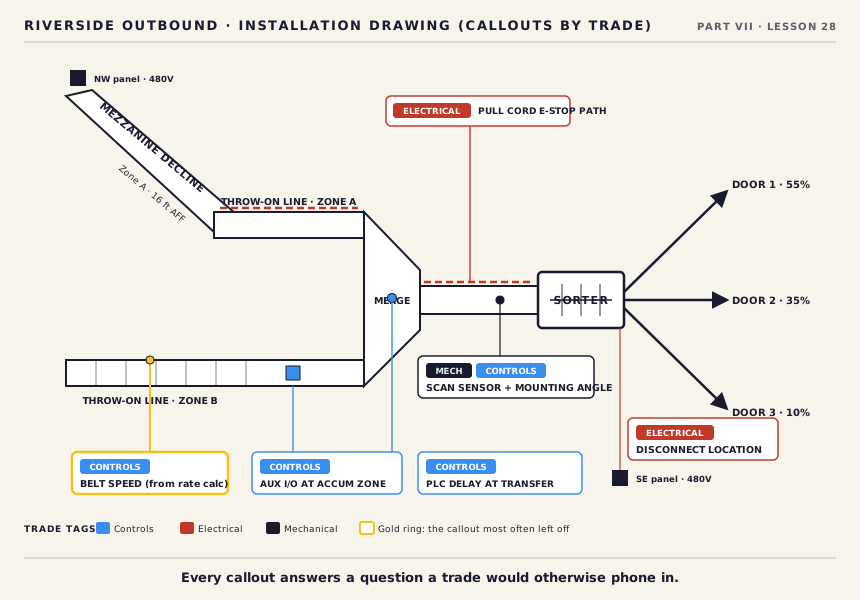
Steel gets bolted to the floor. Wire gets pulled. Panels get mounted and sensors get placed. Every one of those trades is working from the drawing you produced, and not one of them was in the room when you made the decisions behind it. Your drawing is the only version of your thinking they ever get to see.
When the drawing is right, everything downstream of it can be right. When it's wrong, incomplete, or ambiguous, the people working from it fill the gaps with assumptions, because they have a system to build and a schedule to hit. Assumptions on paper cost you a redraw. Assumptions in the field cost money and time, and they cost it in front of the customer.
So the drawing isn't a starting point that gets figured out on site. It's the plan. The phone stays quiet when the plan is complete, and it starts ringing the moment it isn't.
By the end of this lesson you should be able to name what belongs on an installation drawing and which trade needs each item, run the pre-release interview that surfaces what's missing before the drawing goes out, and check every vendor RFQ for the scope gaps that quietly come out of your margin.
An installation drawing that works in the field is one that answers every question a trade might have without a phone call. That standard sounds high, and it's reachable. It starts with knowing that a drawing isn't one document for one reader. It's the instruction set for three trades at once, and each of them reads it looking for different things. Here is what belongs on the sheet, tagged with who needs it and what happens on the floor without it.
Read that list as questions instead of items, and you hear the phone calls you're preventing. What speed do I set this line to? Where does the pull cord run? What angle do I mount this sensor at? Every one of those is a decision you already made. The drawing is where you hand it over.
Notice what this section is doing and what it isn't. The speeds, the delays, and the release modes were engineered upstream, where the setpoints and the controls architecture got built. The guarding, the pull cord path, and the underside covers came out of validating the design for the people who work near it. This lesson doesn't re-derive any of that. It places those decisions on the sheet where the trades can find them. The deep controls work belongs to Part V, and the guarding standard to the validation part. Here, your job is completeness, not rework.
Leaving the speed callouts off the drawing. Every belt speed you calculated to hit the throughput target means nothing if it isn't on the sheet the controls team programs from. They program what they receive. If the setpoints are missing, they estimate, and an estimate isn't engineering. This is why the gold ring on the drawing sits on the speed callout. It's the item that got the most calculation behind it and gets left off the sheet the most.
You're releasing an installation drawing tomorrow. Name the three vendors you'd call first and the one specific thing you'd ask each of them. If your answer is generic, you haven't done the exercise. The point is the specific callout each trade needs and you might have left off.
The one discipline that makes a drawing work in the field is this: before you release it, you talk to every vendor and you ask each one what they need to see on it. Call the controls team. Call the mechanical contractor. Call the electrical contractor. Ask each one the same specific question. What do you need to see on this drawing to execute your scope without ambiguity? The answers tell you what's missing. You add it before the drawing goes out.
This step gets skipped for a reasonable-sounding reason. Engineers assume the mechanical installer already knows what they need, and that the controls team will ask if something is missing. The trouble is that people don't always know what they don't know. A controls programmer who has never seen a system like yours doesn't know to ask for the speed callouts until the VFDs are in front of them and there's nothing on the sheet to program. A mechanical installer in a tight bay doesn't know to ask for the clearance dimension unless it's shown. The gap doesn't announce itself. You have to go looking for it, and the way you look is by asking.
The best time to catch a drawing error is on that phone call. The worst time is during installation, with a crew standing around a sheet that doesn't answer their question.
If you're about to release a drawing for construction, then call every vendor individually first and ask each one the same question: what do you need to see on this drawing that isn't there yet. Tradeoff: three phone calls and a day you'd rather spend finishing the sheet. Verify: the answers will improve every drawing you ever produce, and the callout you add today is the RFI you don't answer next month.
The drawing is the golden plan. Every trade on the job site is working from what you put on it. If the speed callouts are missing, the controls team doesn't know what the plan was. If the pull cord path isn't shown, the electrical contractor doesn't know it's required. If the equipment dimensions are wrong, the mechanical installer builds to the wrong footprint. Get the drawing right before the project mobilizes. Everything else depends on it.

Vendors price what they're told. The electrical installer, the mechanical installer, and the controls company all build their number from what's in the RFQ, and only from what's in the RFQ. If the electrical contractor isn't told that pull cord E-stops are required throughout the facility, they won't include them. If the scope doesn't specify that every motor needs a VFD, that cost won't appear in the estimate. The vendor didn't miss anything. They priced exactly what you handed them.
So the gap between what was scoped and what the vendors actually priced comes out of project margin, and it's your gap, not theirs. You own the scope definition. The vendor who under-priced a pull cord run because it wasn't in their RFQ adds it back as a change order, and that comes out of the number you already committed to the customer.
The standard is completeness, checked trade by trade against the design:
That last line is the discipline. You don't just send the RFQs and take the numbers back. You lay each quote next to the design and hunt for the thing that isn't there. The gap you catch here costs a phone call. The gap the vendor catches after award costs margin.
Back to Riverside. Every setpoint and every dimension the earlier deliverables produced now has to land on one drawing: the belt speeds by section, the VFD ramp rate on the mezzanine decline, the scan point and sensor locations, the PLC delay values at the transfer points, the accumulation zone release modes, the pull cord E-stop path and reset locations from the guarding audit, the Aux I/O module locations, and the disconnect locations at the two 480V panels in the northwest mechanical room and the southeast corner. You don't re-run the gap or sorter math. It's done. It goes on the sheet as a callout, not a fresh calculation.
Michael walked the mezzanine edge with you during the facility walk. What he said then is still the hardest part of this drawing: "That mezzanine edge is going to be your challenge. Whatever comes down from up here has to land somewhere before it can go south. You have got about 40 feet of horizontal run from the mezzanine edge to where the ground floor zone ends. After that you are in the main aisle. Forklifts run that aisle all shift." And: "We had two near misses last year."
Assemble the installation drawing package. Then run the pre-release interview. Call the mechanical installer about the decline landing and the forklift-crossing structure. Call the electrical contractor about the pull cords and the VFDs across both panel locations. Call the controls team about the WMS interface and the setpoints. Write down the one callout each trade would ask for that isn't on your sheet yet. Then check the three vendor RFQs for the margin gaps: pull cords in the electrical RFQ, a VFD on every motor that needs one, the Aux I/O list and WMS interface in the controls RFQ. The walkthrough where every trade reads the drawing together is a separate meeting, and it belongs to Part VIII. This is the pre-release pass that makes the drawing complete before it goes out.
This is Lesson 28, the front of Part VII, and the whole part turns on one shift: the engineering stops living in your head and becomes a document other people can act on. Nothing gets built from a system that lives in the engineer's head. The drawing is where the validated design becomes the trade instruction set, and the question on the gold banner is the test for every line on it. Can every trade build their scope from this drawing without calling you? The business case comes next, and the proposal after it, and both build on this same habit of completeness before release. Get the drawing right before it goes out, and everyone downstream of it inherits a plan instead of a guess.