MATERIAL HANDLING ACADEMY

Part VII. Lesson 29. The Business Case.

DRIVING QUESTION Does this system pay for itself, and can I prove it?
PART VII | LESSON 29: THE BUSINESS CASE
THE FINANCE CHAIR | TOM RUIZ, VP OF FINANCE

"I will be brief. If this project does not make financial sense I cannot support it regardless of the operational benefit. I will need to understand the return before we go any further."

That sentence ends more technically correct projects than any engineering flaw ever will. Tom isn't being difficult. He's telling you the rule the whole room runs on.

PART VII | LESSON 29: THE BUSINESS CASE
DESIGN PRINCIPLE The business case is engineering. Build it from confirmed inputs.

Build it the way you build a calculation, from confirmed inputs and not guesses. Defend it line by line. Be honest about what it does and doesn't include. The engineer who can do the system math and the money math is the one who gets the project built.

PART VII | LESSON 29: THE BUSINESS CASE

Three Savings, One Number

Add the three and you've got annual savings. Confirm every input in writing before it goes in the model.

PART VII | LESSON 29: THE BUSINESS CASE
COMMON MISTAKE

Quoting an industry-standard payback. There isn't one. Payback runs from under two years for simple mechanization to five or more for full AS/RS, and the approval threshold is a number each company sets for itself. Tell a customer the industry expects a three-year payback and the first finance person in the room who knows better stops trusting the rest of your numbers.

PART VII | LESSON 29: THE BUSINESS CASE

Payback Is Simple

Illustrative only, not Riverside's figures

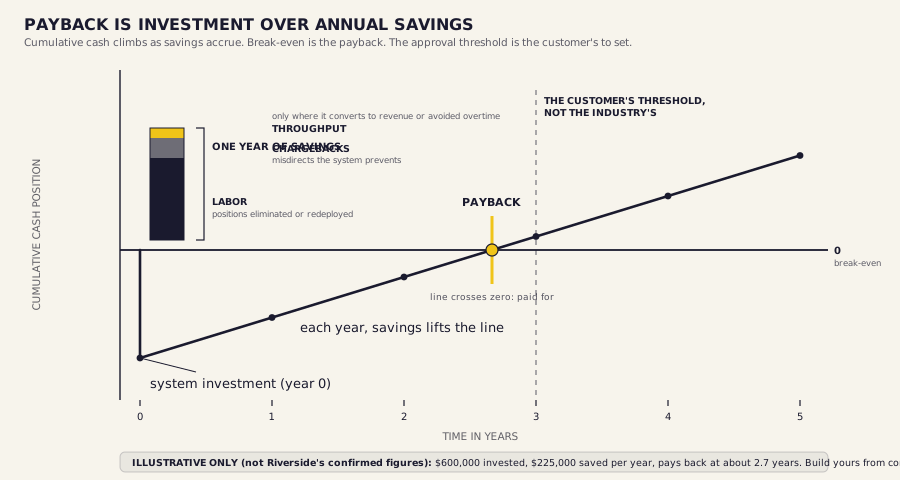
Say a system installs for $600,000, and you've confirmed $225,000 in annual savings: $170,000 in labor, $40,000 in chargeback reduction, $15,000 in avoided peak overtime.

$600,000 ÷ $225,000 per year = about 2.7 years

Total investment divided by annual savings. Against a three-year threshold, this clears, with room.

PART VII | LESSON 29: THE BUSINESS CASE
A cumulative cash line chart over five years. The line steps down at year zero to the system investment, then climbs each year as annual savings accumulate, crossing the zero break-even line partway through year three, marked in gold and tagged payback. A dashed vertical marker at year three is labeled the customer's threshold, not the industry's.
Payback is investment over annual savings. The threshold is theirs to set.
PART VII | LESSON 29: THE BUSINESS CASE
PRO TIP | MC

If the customer hands you a payback threshold, then build the case against their number and confirm every input that feeds it in writing before you present it. Tradeoff: it's slower than quoting a rule of thumb, and finance people ask hard questions. Verify: when Tom asks where the labor number came from, you have the email that confirmed it. A business case you can source is a business case you can defend.

PART VII | LESSON 29: THE BUSINESS CASE

Price the Outlier Both Ways

Include the outlierExclude the outlier
System handles everything the customer ships today. System is optimized for the core volume that carries the operation.
Customer doesn't have to manage exceptions manually. System may be smaller, faster, or less expensive.
Cost reflects the full product range. Customer makes an informed business decision about the outlier.
PART VII | LESSON 29: THE BUSINESS CASE
FIELD INSIGHT | MICHAEL COLLINS

If a product outlier is driving the whole system in an expensive direction, put a number on it. Show the customer what it costs with that outlier in and what it costs with it out. You don't even have to draw it twice to start the conversation. A per-foot price difference between two conveyor widths is enough to show them the trade, and it can save you from drawing the whole system twice. Give them the information and let them make the call. That's their decision to make, not yours.

Michael Collins
PART VII | LESSON 29: THE BUSINESS CASE

Riverside

RIVERSIDE PROJECT

Build the case against Tom's three-year threshold. You're building the structure, not a finished dollar figure, because Tom gave you the framework and held back the numbers on purpose. Labor from the manual sort and staging, chargeback reduction from the roughly three percent misdirect rate, throughput headroom only if it converts.

Write the formula: total investment divided by annual savings. Then mark what's still open. The headcount, the fully loaded cost per associate, the chargeback cost per incident. Every one is a confirm-with-Tom-in-writing item, not a number you get to assume.

Next: Does this proposal give the customer enough to make a real decision?