PART VIII | LESSON 32: THE HANDOFFMATERIAL HANDLING ACADEMY
DRIVING QUESTIONBefore the first bolt turns, does everyone know what I know?
MONDAY MORNING | RIVERSIDE SAYS YES
Riverside said yes. The proposal's approved, Tom signed off, Dana's ready to move, and the project's live. Your instinct is to call a vendor and order steel. Hold on. That's not the first move.
The first move is the handoff. Before anyone mobilizes, you get every trade on the same page about what you know that they don't. The execution phase is where the design meets the real world. Steel gets bolted to the floor, wire gets pulled, panels get mounted, and the drawing you spent weeks producing becomes the instruction set every trade works from. Get the handoff right and the project runs. Skip it and the phone starts ringing.
By the end of this lesson you should be able to run a pre-execution handoff that surfaces every non-obvious decision before mobilization, name every trade interface where a gap can open and confirm every vendor's working from the same scope, and plan a cutover that brings a new system live inside an operation that still has to ship every day.
The drawing is the plan you hand off
Every person on the job site works from your drawing. The mechanical installer positions equipment from it. The electrical contractor routes conduit from it. The controls team mounts panels, places sensors, and programs setpoints from it. When the drawing's right, everything downstream of it can be right. When it's wrong or incomplete, everyone working from it fills gaps with assumptions, and assumptions in the field cost money and time in ways assumptions on paper never do.
The handoff is the moment you release that drawing as the plan and stand behind it. It isn't a starting point anymore. It's the instruction set. What belongs on it, the callouts each trade needs, the completeness that makes an RFQ whole, that's Lesson 28's ground, and it's done by the time you get here. Part VIII doesn't re-teach the drawing's contents. It releases the drawing and defends it.
The handoff meeting: surfacing the skeletons
Here's the whole problem with a handoff in one line: we don't know what others don't know.
You engineered a belted induction section upstream of the merge because of the air accumulation risk, and you assume the controls team knows why it's there. The controls team assumes the mechanical team knows the transfer sensor has to sit offset from center by the PLC-delay amount. Nobody's wrong. Nobody communicated what they knew. That gap is where field problems get born.
A good handoff is one where the execution team and every subcontractor know where all the skeletons are hiding before the project starts. The skeletons are the non-obvious, judgment-dependent decisions only you can see. The easy things aren't the problem. Everyone knows how to install a straight run of accumulation conveyor. What they don't know is the specific call you made for this project, this customer, this building, and why you made it.
So you run a meeting. Not an email, a meeting. You walk the drawing with every trade in the room, and you call out every non-obvious decision and the intent behind it. The installer doesn't need the full calculation. They need to know what the decision was protecting, so they build it the way it was meant to be built instead of the way that looks fine on a busy morning.
FIELD FOOTAGE | Surfacing the Skeletons
Surfacing the Skeletons90 to 120 secondsRecording coming
Michael Collins is talking through why the handoff is a meeting, not an email. The write-up above carries the skeletons meanwhile.
WHYThe handoff is where you surface the skeletons, the non-obvious decisions only you know, before they turn into field problems. The engineer who hands off a complete, well-communicated package runs projects on schedule. The one who treats the drawing as a starting point generates change orders and callbacks.
WHENBefore the first subcontractor mobilizes. The vendor calls, the drawing review, and the walkthrough all happen before anyone sets foot on the site. Not when: Not the project manager alone. Every subcontractor who'll be on site needs to be in the room. The controls team can't act on a decision they never heard, and the meeting's the one time you've got all of them at once.
WHEREA meeting with every trade in the room, plus a released drawing that stands on its own after the meeting ends.
FAILURE IF IGNOREDYou skip the walkthrough, the trades fill the gaps with assumptions, and the merge gets built without the belted induction section because nobody told the installer why it was there. It shows up as a jam a month after go-live, and now it's a field fix instead of a five-minute callout.
FIELD INSIGHT | MICHAEL COLLINS
A good handoff is one where the execution team and every vendor know where all the skeletons are hiding. The easy stuff isn't the problem. Everybody knows how to install a straight run of conveyor. It's the decisions that took judgment to get right that nobody else can see. We don't know what others don't know, so we've got to make sure everyone's on the same page. That means a meeting, a drawing walkthrough, and a specific callout for every non-obvious decision in the design. If you engineered something that needed judgment to get right, that judgment gets communicated before the project starts, not discovered in the field.
COMMON MISTAKE
Treating the handoff meeting as a substitute for the drawing. A great walkthrough isn't a complete drawing. Verbal instructions given in a meeting get forgotten. A detail discussed out loud but never drawn doesn't exist when a dispute comes up six months later. The meeting surfaces the skeletons. The drawing has to stand on its own after everyone goes home.
Trade interfaces and scope confirmation
Two disciplines live inside the handoff meeting, and both are about seams.
First, identify every interface between trades. Where does the mechanical scope end and the electrical scope begin? Where does the electrical scope end and the controls scope begin? Every interface is a potential gap, because each trade assumes the other side's got it covered. At the panels, mechanical hands off to electrical. At the Aux I/O and the WMS interface, electrical hands off to controls. Name each seam out loud in the room, and make one trade responsible for each side of it.
Second, confirm what every vendor received in their scope package. If anything was missing from an RFQ, surface it now, before it surfaces as a change order. Every vendor should be working from the same scope definition, not a different version of the design. The electrical RFQ carries the pull-cord E-stop runs and the panel locations. The mechanical RFQ carries the equipment list and the access requirements. The controls RFQ carries the Aux I/O list, the WMS interface scope, and the machine-level setpoints. Read each one against the released drawing and close any gap you find.
Then agree on the redline process before anyone mobilizes: how field changes get documented, who approves them, and how they get back to the engineer for as-built updates. You only agree on the process here. Running it, evaluating each change for downstream impact and carrying a redline back to an honest as-built, is Lesson 33's job.
PRO TIP | MC
If you're about to release a drawing for construction, then call every vendor individually first and ask each one the same question: what do you need to see on this drawing that isn't there yet? Tradeoff: it's a handful of phone calls you'd rather skip when the schedule's tight. Verify: the answers tell you what's missing, and the drawing you release after those calls generates a fraction of the field questions.
Brownfield cutover: bringing it live without going dark
A new system rarely goes into an empty building. It goes into an operation that still has to ship every day. You can't take the whole floor dark for two weeks while you install, and Riverside can't go dark for even one shift. So the cutover gets planned with the same discipline as the design. Three ideas carry it.
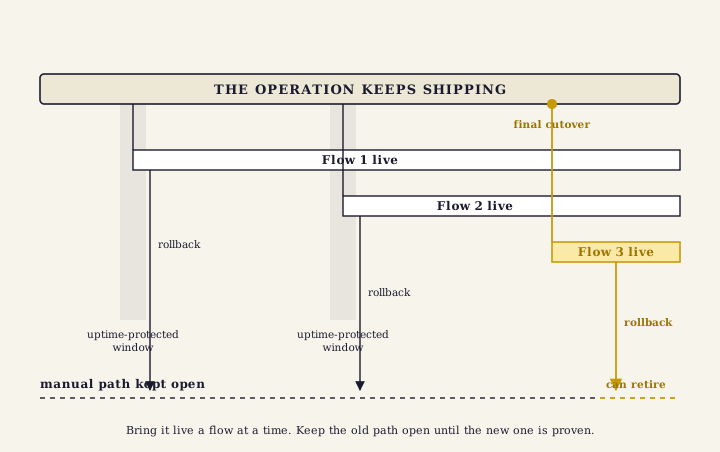
Phased migration. Bring the system live a zone, a lane, or a flow at a time. The operation keeps running on the old path while the new path is proven section by section. You never bet the whole floor on one switch getting thrown correctly.
Rollback plan. For every phase, know how you fall back to the working state if the new section isn't ready. Keep the manual or legacy path available until the new one is accepted. A phase you can't back out of is a phase you shouldn't cut over.
Uptime-protected commissioning windows. Schedule the disruptive work into windows the operation can absorb: off-shift, between waves, on a light-volume day. Commissioning never competes with a truck that has to load.
A system that can't be brought live without stopping the business isn't finished being designed. Proving each section on the floor and getting it accepted is Lesson 34, the commissioning and acceptance work. Here you plan the cutover. Lesson 34 runs it.
Phased by flow. Each rollback arrow returns to the manual path, which stays open until the last flow is proven.
STOP AND THINK
The customer ships every day and can't go dark, not even for one shift. You've got a system to install across their outbound floor. Before you schedule a single hour of disruptive work, name the one thing you protect above the install schedule, and the path you keep open in case a new section isn't ready on cutover day.
RIVERSIDE PROJECT
Back to Monday morning. Riverside said yes, and the debrief question your mentor puts to you is the one that opens this whole part.
Riverside says yes. The proposal is approved. Tom signed off. Dana is ready to move. It is Monday morning. The project is live. What is the first thing you do and who is the first person you call?
There is no single correct answer to that question. There is a well-reasoned answer and a poorly-reasoned one. Your mentor will ask you to explain yours.
The well-reasoned answer starts with the handoff, not the vendor call. Get the room right first. Every trade that'll be on site, and Michael, the maintenance lead who works alone and has watched two systems fail on this floor. He lives with whatever you hand off long after the install crew drives away, so he's in the room from the start.
Then surface Riverside's skeletons: the belted induction ahead of the merge, the mezzanine-decline landing, the offset transfer sensors, the forklift-aisle crossing. Name the interfaces where each one could get dropped: mechanical to electrical at the panels, electrical to controls at the Aux I/O and the WMS interface. And plan the cutover, because Riverside ships every day and can't go dark. Phase it by flow, and keep the manual staging path open as your rollback until each flow is proven.
Build Riverside's handoff package checklist below. Write who's in the room next to the agenda, and name your first rollback next to the cutover plan.
RIVERSIDE HANDOFF PACKAGE CHECKLIST
Drawing release confirmation. The installation drawing is released as the plan, complete and reviewed with every trade before mobilization.
Pre-execution meeting agenda. Every subcontractor plus Michael in the room, a drawing walkthrough, and every non-obvious decision called out with its intent.
Trade-interface list. Every seam named, mechanical to electrical at the panels, electrical to controls at the Aux I/O and the WMS interface, with one trade owning each side.
Scope-package confirmation. Every vendor working from the same scope, each RFQ checked against the released drawing, any gap closed before it becomes a change order.
Brownfield cutover plan. Phased by flow, uptime-protected windows scheduled off the shipping peak, the manual staging path kept open as rollback until each flow is proven.
Redline process agreement. How field changes get documented, who approves them, and how they return to the engineer for as-built updates, run in Lesson 33.
FOREST THROUGH THE TREES
This is Lesson 32 of thirty-five, and it's the hinge where design becomes construction. Every calculation you ran, every technology you selected, every line you drew now becomes an instruction set for a project that's physically happening. The handoff is the test of whether that engineering was complete, because a decision that lived only in your head is a decision the field gets to make for you. Surface the skeletons, name the seams, confirm every vendor's scope, and plan a cutover that protects the truck that still has to load. Do that, and the design leaves your hands as a plan instead of a guess. Before the first bolt turns, everyone knows what you know.
CHECKPOINT
You're preparing to release an installation drawing package. You've talked to the mechanical installer, who says it looks good. The controls team hasn't answered your two emails. The project manager's pushing you to release because mobilization is in four days. What do you do, and what's the failure mode you're trying to avoid by not simply releasing on schedule?
You're reviewing RFQs before the handoff meeting. The electrical RFQ lists the pull-cord E-stop runs and the panel locations, and the controls RFQ lists the Aux I/O list and the WMS interface scope. The mechanical RFQ never lists the access requirements the installer needs to service the equipment. What do you do about the gap, and why does closing it now matter more than waiting for it to show up later?