Part VIII. Lesson 33. Execution Support.
The trades are mobilized, steel is going up, and your phone rings from the site. Answer in two minutes and you save the installer an hour of downtime. Let it roll to voicemail and that same question turns into a field decision made without an engineer, on half the information.
During execution your availability isn't passive. It's active. You check in. You ask if there are questions. You're done being the producer. Now you're the resource.
You're the architect of this solution. You know why the sorter is that model, why the accumulation zones are sized the way they are, what the speed calculations showed, and what margin got built in. When a field question comes in, that knowledge is what the field needs to get at, quickly.
There's a lane, and you stay in it. The project manager owns schedule, budget, and subcontractor coordination. You own the design. Be excellent at the half that's actually your job.
What makes you quick isn't memory. It's the folder.
Your first question is never yes or no. It's: what else does this affect?
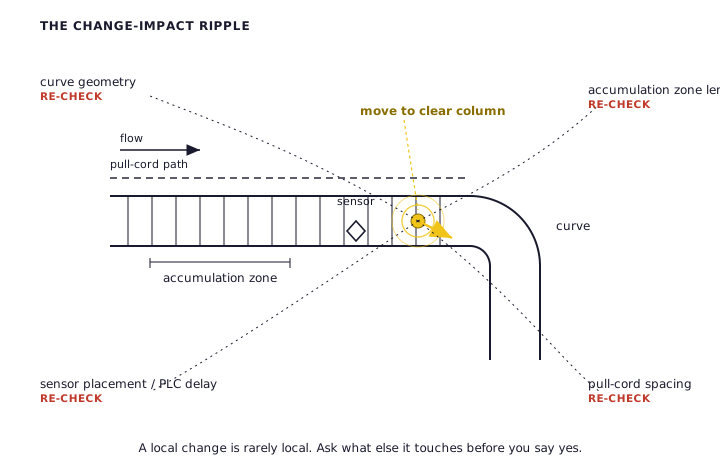
A change to one section never happens in isolation, because the drawing connects everything. A two-foot position shift can move curve geometry, accumulation zone length, sensor placement, and pull-cord spacing at the same time. You evaluate every change for downstream impact, document the evaluation, and if it needs design work, that work happens before the field proceeds.
| Change requested | The question you ask first |
|---|---|
| Equipment position moved | Does this force changes upstream or downstream too? A position shift rarely stays local. |
| Conveyor model substituted | Does the substitute match the speed range, the weight capacity, the zone length, and the roller centers the product needs? |
| Sensor relocated | Does the new position still give correct detection for the PLC delay the timing depends on? |
| Setpoint adjusted at startup | Was the original speed set to a throughput target? What happens to rate if it moves? |
| Safety device relocated | Does the new location still give required coverage, and can operators still reach the pull-cord? |
The engineer owns the installation drawings, the as-builts, and the review of every redline from the field. When a change gets made out there, it's my job to know what else that change touches and weigh that against what they're asking for. A change to one section never happens in isolation. The drawing connects everything. So before I approve anything, I think through the downstream effects, and then I capture what actually got built in the as-built. That as-built is a legal document. Five years from now, when the customer wants to expand, somebody designs from it. If it doesn't match reality, they're starting from a lie.

Letting redlines die on the clipboard. Redlines that stay in the field never become as-builts, and an as-built that doesn't exist can't be referenced when something fails or when the customer expands. Collect them at every visit, not at the end. Process them right away. The project isn't complete until the drawing reflects what was actually built.
During installation the crew finds the horizontal run off the mezzanine edge is obstructed, and the mechanical installer wants to shift where the powered decline lands to clear it. Your first question isn't yes or no. You run it through the matrix.
Shifting the landing changes the decline angle, which touches the tumble limit for the Tall Case, the 10 by 8 by 14 carton flagged back in Part II and Part IV. It moves the accumulation zone ahead of the merge. It shifts the sensor the PLC delay depends on. It changes pull-cord spacing. Evaluate each, document it, then capture the approved change as a redline headed for the as-built. The tumble and gap math is Lesson 14 and Lesson 25; today the skill is knowing the change reaches those calculations before you approve it.
Next: How do we prove it works, and who keeps it running after we leave?