MATERIAL HANDLING ACADEMY

Part VIII. Lesson 35. Becoming the Engineer.

DRIVING QUESTION I finished the program. Am I ready to run one alone?
PART VIII | LESSON 35: BECOMING THE ENGINEER

Finishing Is Not the Same as Being Ready

You finished the program. That means you understand the methodology. It does not mean you're ready to run a project alone. Those are two different things, and confusing them is where a new engineer tends to slip in the first six months.

The methodology handles the technical part. What it can't hand you is the pattern recognition that only comes from repetition, on real projects, with real customers and real consequences.

PART VIII | LESSON 35: BECOMING THE ENGINEER
COMMON MISTAKE

Treating a finished program as a finished engineer. Finishing means you know how the work is done. It doesn't mean you have the pattern recognition to do it unsupervised. That only comes from repetition on real projects. Treat the first 90 days as where you build it, not as a formality you've already earned past.

PART VIII | LESSON 35: BECOMING THE ENGINEER
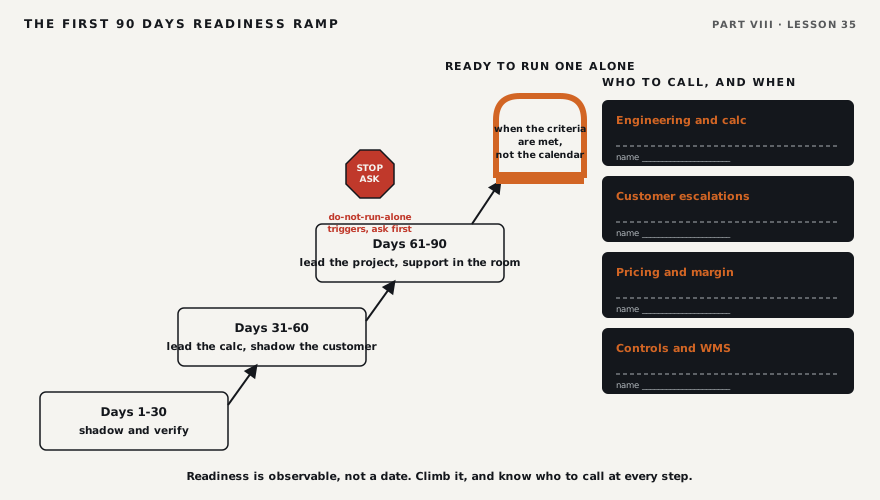
The first 90 days readiness ramp: three ascending steps labeled Days 1-30 shadow and verify, Days 31-60 lead the calc and shadow the customer, and Days 61-90 lead the project and support in the room. A gold gate at the top reads ready to run one alone, when the criteria are met, not the calendar. A stop-sign marker before the gate reads do-not-run-alone triggers, ask first. A four-box escalation panel lists engineering and calc, customer escalations, pricing and margin, and controls and WMS, each with a blank name line.
Readiness is observable, not a date. Climb the ramp, and know who to call at every step.
PART VIII | LESSON 35: BECOMING THE ENGINEER

Your First 90 Days

Days 1-30

Shadow and verify. You're present on every visit, not leading. Run the calculations yourself and compare to the senior engineer's. When you disagree, find out who's wrong before the proposal goes out.

Days 31-60

Lead the calc, shadow the customer. You run the spec calc and present your numbers for review. You draft scope and limitations. Not yet owning the customer relationship.

Days 61-90

Lead the project, support in the room. You run your first project with a senior available but not leading. The senior reviews before anything goes to the customer.

PART VIII | LESSON 35: BECOMING THE ENGINEER
FIELD INSIGHT | MICHAEL COLLINS

Some engineers pull ahead fast in their first year. The ones who do are the ones who ask specific questions. Not how do I get better at this. That gets you a general answer. I mean something like, I got a gap check failure on the sorter at twenty cartons a minute, I tried increasing the sorter speed, and then the takeaway spur spec went above catalog maximum, walk me through how you would approach that. A specific question like that gets you a specific answer you can actually use. Ask the small, exact question. It's worth ten of the big vague ones.

Michael Collins
PART VIII | LESSON 35: BECOMING THE ENGINEER

What You Don't Run Alone Yet

THE RULE OVER THE LIST

If you're not sure whether a situation belongs on this list, it does. Ask first. The question costs you five minutes. Getting it wrong costs the firm a bad proposal and costs you credibility that takes months to rebuild.

PART VIII | LESSON 35: BECOMING THE ENGINEER

How You Know You're Ready

PART VIII | LESSON 35: BECOMING THE ENGINEER
WHYMisjudge readiness in either direction and it costs you. Run one alone too early and the mistake shows up at commissioning, not at signing. Wait too long and you never build the judgment that only real projects give you.
WHENWhen you can meet the observable criteria honestly, not when a calendar says a number, and above all when you can name what you don't know on a project before anyone asks.
WHEREOn live projects, with a senior engineer available, through the first 90 days and the first solo project after.
NOT WHENNot because 90 days passed. Not because you finished the program. And not on any project that sits on the do-not-run-alone list, no matter how ready you feel. If you can't yet name the edges of your own knowledge, you're not there.
FAILURE IF IGNOREDYou promise a customer a rate the system can't reliably hold because it felt achievable and nobody checked you. That problem doesn't show up at signing. It shows up at commissioning, in front of the customer, and now it's yours.
PART VIII | LESSON 35: BECOMING THE ENGINEER

The Eight Habits

  1. Get the required rate in writing before you run any calculations.
  2. Never design to the average carton. Design to the worst case, and document which carton it is.
  3. Always run the gap check. Every time. No exceptions.
  4. Document every assumption at the time you make it.
  5. Never let an open item stay open past the next customer touchpoint.
  6. Read the flow diagram cold before the proposal goes out.
  7. Ask the customer what a bad day looks like.
  8. Separate what you know from what you were told.
PART VIII | LESSON 35: BECOMING THE ENGINEER

Riverside

RIVERSIDE PROJECT

You've walked the whole journey now. Dana's voicemail in Part I. The product and the flow, the conveyance and the intelligence, the validation and the proposal, and in this part the handoff, the execution support, and a commissioned, accepted, serviced system.

Hold Riverside against the readiness criteria. Could you run that project solo today, from the first voicemail to a system that's accepted and running? Build three things: a readiness self-assessment, an escalation map with your organization's real names, and a first-90-days plan. Riverside was the walkthrough. The Capstone is the solo.

Material Handling Academy · The Program Closes Here

"The industry needs engineers who think this way. I am glad you are one of them."

Michael Collins, Sr. Solutions Engineer

Now go to the Capstone and run the whole thing yourself, from Dana's first voicemail to an accepted system.