PART VI | OPENER MATERIAL HANDLING ACADEMY
PART VI

Validate the Design

By now you've got a whole system on paper. Every conveyor sized, every speed set, every controls layer drawn. And every number on it came out of a calculator that assumed a perfect world: a rigid box, a new belt running at exactly the commanded speed, clean air, every roller present and spinning. The real world honors none of that. This part is where you find out which of your numbers survive contact with a slipping belt, a shifted load, a maintenance team of one, and a person reaching into the line to clear a jam at 2 AM. You prove the rate. You prove it stays up. You prove it's safe for the people around it. The calculator was never the answer. It did the arithmetic fast so you could spend your judgment on the part that actually decides whether this system works. That judgment is the whole job, and this is where you sign your name to it.
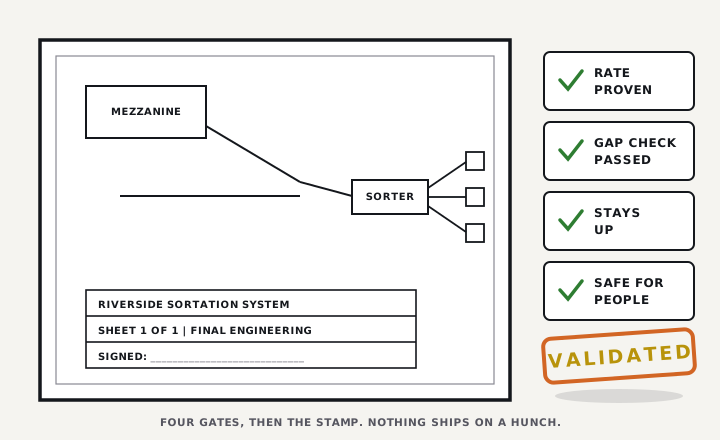
An editorial line sketch of a released drawing sheet on a desk showing the Riverside system in plan view. Down the right margin, four validation gates read rate proven, gap check passed, stays up, and safe for people, each checked. A red pen rests across the drawing, and a gold stamp reading VALIDATED hovers above the signature block, poised but not yet pressed.

The calculator got you here. Judgment decides whether you sign it. This is Part VI.

LESSON 24

The Perfect World Problem

DRIVING QUESTION Where does the calculated answer stop being true, and how much margin does it need?
LESSON 25

The Gap Check and Capacity Proof

DRIVING QUESTION Does this system actually hit its rate, and does the gap survive every check?
LESSON 26

Reliability Engineering

DRIVING QUESTION When this system fails, how fast is it back up, and can this customer keep it running?
LESSON 27

Validate for People

DRIVING QUESTION Is this system safe for the person who works beside it and fixes it at 2 AM?
Begin Lesson 24: The Perfect World Problem Part VI checkpoint